


Pregnancy
8 hours ago
Q: How do we know babies grow well in pregnancy? Are there any symptoms and I am feeling hungry more than before like within 5hrs in the night?
 3Answer


Quick Answer
Feeling hungrier than usual in pregnancy is normal, but you do not need to eat for two. Meals and snacks built around protein, such as dal, paneer, eggs, curd and nuts, keep you full longer than sugary snacks. On low appetite days, a protein supplement for pregnancy such as MamaGro Pregnancy Protein Powder can help.
If you find yourself raiding the kitchen an hour after dinner, or waking at night with a rumbling tummy, you are not alone. A bigger appetite is one of the most common changes in pregnancy. The aim is not to eat more of everything, but to choose foods that actually keep you satisfied. Here is why the hunger happens, what helps, and when it is worth telling your doctor.
Why am I always hungry during pregnancy?
Your body is working hard to grow your baby, the placenta and extra blood, so your appetite often goes up. The NHS says you will probably find that you are more hungry than usual, but you do not need to "eat for 2", even if you are expecting twins or triplets (NHS).
How much extra do you actually need? According to ICMR-NIN 2020, a pregnant woman needs about 350 extra kcal a day, roughly one extra small meal such as a katori of dal with a roti and a glass of milk (ICMR-NIN). Hunger often feels much bigger than that, which is why the type of food you choose matters so much.
Why does protein keep you full longer?
Protein is one of the most filling nutrients. A research review found that dietary protein helps people feel full and satisfied, even when they are eating less overall (Westerterp-Plantenga et al., 2012). Sugary biscuits and refined snacks, on the other hand, digest quickly, so hunger can return soon after.
Your protein need also rises in pregnancy. ICMR-NIN 2020 recommends about 9.5 g of extra protein a day in the second trimester and about 22 g extra in the third trimester (ICMR-NIN). Our guide on how much protein you need in pregnancy explains your daily total.
Which foods keep you full the longest?
Meals that combine protein with fibre and a little healthy fat keep hunger away the longest. The NHS advises eating some protein rich foods every day (NHS).
Filling foods for pregnancy
Food type | Indian examples | Why it helps |
|---|---|---|
Protein | Dal, rajma, chana, paneer, curd, eggs, sprouts, soya, milk | Keeps you full longer |
Fibre | Whole wheat roti, oats, dalia, millets, fruit, vegetables | Adds bulk and slows digestion |
Healthy fats | Nuts, seeds, a little ghee | Helps meals feel more satisfying |
Why do I feel hungry at night?
Many women notice that dinner does not last until morning, especially as pregnancy goes on. A long gap between dinner and breakfast, an early or light dinner, or a carb heavy last meal can all leave you hungry in the night.
What can help:
Add protein to dinner, such as dal, paneer, egg bhurji or curd with your roti or rice.
Have a small, filling snack before bed: a glass of warm milk, a handful of nuts, a small bowl of curd, or roasted chana.
Keep a simple snack by the bed, such as a few almonds or a banana, so you are not tempted by biscuits at 2 am.
Eat a proper breakfast in the morning. The NHS says a healthy breakfast every day can help you avoid snacking on foods high in fat and sugar (NHS).
If heartburn wakes you, keep the bedtime snack small and avoid lying down straight after eating.
What are smart ways to manage constant hunger?
A few simple habits keep hunger steady through the day:
Start with protein: add curd, eggs, paneer, sattu or moong chilla to a poha or paratha breakfast.
Eat small meals often: 5 or 6 smaller meals can feel easier than 3 large ones.
Snack smart: choose roasted chana, makhana, sprouts, fruit, curd or nuts instead of sweets, biscuits or chips, which the NHS suggests limiting (NHS). Our list of high protein Indian snacks for pregnancy has more ideas.
Drink water: sip through the day, as thirst can feel like hunger.
Do not skip meals: long gaps often lead to overeating later.
On busy or low appetite days: a protein supplement for pregnancy such as MamaGro Pregnancy Protein Powder mixed in milk can help, alongside meals, never instead of them.
Pregnancy hunger: myths or facts?
Do I need to eat for two because I am always hungry?
No. You will probably feel hungrier, but you do not need to eat for two, even with twins (NHS).
Do sweets and biscuits satisfy hunger best?
No. Sugary snacks digest quickly, so hunger comes back soon. Protein and fibre keep you full for longer.
Will skipping a meal help control my appetite?
No. Long gaps usually make you hungrier later. Small, regular meals work better.
Can a protein drink replace my meals?
No. A protein supplement can help on low appetite days, but it supports balanced meals and does not replace them.
When should you see a doctor?
Increased hunger is usually normal. Tell your doctor if you have:
increased thirst, needing to pee more often than usual, and a dry mouth, which can be signs of high blood sugar. The NHS advises seeing your doctor without waiting for your next test (NHS). Read about the OGTT and gestational diabetes screening.
very fast or very slow weight gain
hunger with tiredness, dizziness or feeling unwell
hunger that comes with nausea or vomiting that stops you keeping food down
Frequently Asked Questions
Is it normal to feel hungry every few hours in pregnancy?
Yes. Many women feel hungrier in pregnancy, especially as it goes on. Small, protein rich meals and snacks every few hours help keep hunger steady.
Why do I wake up hungry at night during pregnancy?
A long gap after an early or light dinner is a common reason. Adding protein to dinner and having a small snack before bed, such as warm milk or a handful of nuts, often helps.
Pregnancy mein baar baar bhookh kyun lagti hai? (Hinglish)
Pregnancy mein zyada bhookh lagna normal hai, lekin do logon ka khana khane ki zaroorat nahi hai. Har meal mein dal, paneer, dahi, ande ya nuts jaise protein rakhein, isse pet zyada der tak bhara rehta hai. Raat ko bhookh lage to sone se pehle garam doodh ya mutthi bhar nuts le sakti hain.
How much extra should I eat when pregnant?
About 350 extra kcal a day according to ICMR-NIN 2020, roughly one extra small meal (ICMR-NIN). Your doctor may advise differently based on your weight and health.
Can constant hunger be a sign of gestational diabetes?
Hunger on its own is usually normal. But if you also feel very thirsty, pee more often than usual and have a dry mouth, tell your doctor, as these can be signs of high blood sugar (NHS).
What is a good bedtime snack in pregnancy?
A glass of warm milk, a small bowl of curd, a handful of nuts, roasted chana or a banana are simple, filling choices.
Related Articles
Related Products
References
NHS. Have a healthy diet in pregnancy. https://www.nhs.uk/pregnancy/keeping-well/have-a-healthy-diet/
NHS. Gestational diabetes. https://www.nhs.uk/conditions/gestational-diabetes/
ICMR-National Institute of Nutrition. Nutrient Requirements for Indians, 2020 (brief note). https://www.nin.res.in/rdabook/brief_note.pdf
Westerterp-Plantenga MS, Lemmens SG, Westerterp KR. Dietary protein: its role in satiety, energetics, weight loss and health. Br J Nutr. 2012. https://pubmed.ncbi.nlm.nih.gov/23107521/
Medical disclaimer: This article is for general information only and does not replace advice from your doctor or dietitian.


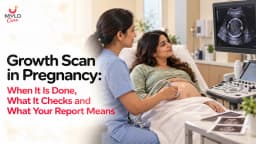
Your doctor has written “growth scan” on your file, or you are holding a report full of letters like BPD, AC and EFW, and one number has caught your eye. Most growth scans simply show a baby growing along their own curve. Here is what the scan looks at, how to read the report, and when a result needs a closer look.
Quick Answer
A growth scan in pregnancy is an ultrasound, usually done in the third trimester, that measures your baby’s head, tummy and thigh bone to estimate weight. It also checks amniotic fluid, the placenta and the baby’s position. Weight estimates can be off by 10 to 15%, so doctors judge growth by the trend across scans, not one number.
What is a growth scan and why is it done?
A growth scan is an ultrasound that checks whether your baby is growing as expected for the number of weeks you are pregnant. Its focus is size, amniotic fluid and wellbeing, not the detailed organ-by-organ check done at the anomaly scan (often called the level 2 scan in India) around 18 to 22 weeks.
Here is where the growth scan sits among the main pregnancy scans, based on NHS guidance on pregnancy ultrasound and ISUOG growth guidelines:
Scan | Usual timing | What it is mainly for |
|---|---|---|
Dating scan, often with the NT scan | 11 to 14 weeks | Confirming the due date and, if you choose, screening for conditions such as Down’s syndrome |
Anomaly scan (level 2 scan) | Around 18 to 22 weeks | A detailed check of the baby’s organs and body structure |
Growth scan | Usually 28 to 36 weeks, earlier and repeated if there are risk factors | Size, estimated weight, amniotic fluid, placenta, position and, when needed, blood flow |
Doctors ask for a growth scan for one of two reasons:
As a routine check. Many hospitals in India schedule one growth scan in the third trimester for every pregnancy.
Because something needs watching. You may have a health condition, a past pregnancy history or a bump measurement that raises the chance of your baby growing too slowly or too fast.
It helps to know what the evidence says. The WHO recommends one ultrasound before 24 weeks for every pregnant woman, mainly to date the pregnancy accurately. A Cochrane review of 13 trials with nearly 35,000 women found that routine ultrasound after 24 weeks in low-risk pregnancies did not improve outcomes for mothers or babies. Ultrasound has no known side effects, so a routine growth scan is not harmful, but it is perfectly fair to ask your doctor, “What are we checking for in my case?”
When is a growth scan done?
Most growth scans happen between 28 and 36 weeks of pregnancy. If you are at higher risk, scans may start at 26 to 28 weeks and be repeated every few weeks until birth.
Your situation | Typical timing |
|---|---|
Low-risk pregnancy, routine hospital check | Once in the third trimester; the exact week varies by hospital |
A known risk factor for a small baby (see the next section) | Serial scans from about 26 to 28 weeks, usually at least 3 to 4 weeks apart |
Your bump measures small, large or stops growing at a check-up | A scan soon after it is noticed |
Twins, diabetes or other conditions your doctor is monitoring | More frequent scans, on a schedule your doctor sets |
International guidance from the International Society of Ultrasound in Obstetrics and Gynecology (ISUOG) notes that a scan at 36 weeks picked up growth restriction better than one at 32 weeks. The same guidance explains why scans are not done every week: weight estimates have a margin of error, and measuring too close together makes “slow growth” look real when it is not. Scans just 2 weeks apart gave false alarms in more than 10% of cases, so a gap of at least 3 weeks is usual unless your doctor needs to check sooner.
If you are not sure which week you are in, the Mylo due date calculator can help you match your scan dates to your pregnancy weeks.
Who may need more than one growth scan?
You may be offered repeated growth scans if something raises the chance of your baby being small or large for their age. The Royal College of Obstetricians and Gynaecologists (RCOG) lists factors such as:
a previous baby who was small for their age, or a past pregnancy with pre-eclampsia (high blood pressure with organ strain) or stillbirth
long-standing high blood pressure, moderate or severe kidney disease, antiphospholipid syndrome (an immune condition that affects blood clotting), or diabetes with blood vessel complications
being 40 or older
smoking
heavy bleeding in the first trimester
a low PAPP-A result (a hormone measured in the first-trimester blood test)
a bump that is hard to measure by hand, for example with a BMI above 35, large fibroids or a lot of amniotic fluid
Many doctors also keep a closer eye on growth if you have diabetes, including gestational diabetes (high blood sugar that starts in pregnancy), because the baby may grow larger than expected. Twin pregnancies are also usually scanned more often.
What happens during a growth scan?
A growth scan is done the same way as your earlier scans. You lie on your back, gel is spread on your tummy, and a probe is moved over the skin while the sonographer takes measurements. According to the NHS, it is painless and usually takes 20 to 30 minutes, though it can take longer if the baby is in an awkward position.
A few practical tips:
Carry your earlier scan reports. Growth is judged by comparing scans, so the old numbers matter.
Wear loose, two-piece clothing, such as a kurta with leggings or a top with a skirt, so your tummy is easy to uncover.
Ask the centre in advance whether you need any preparation, such as drinking water before the scan.
If possible, have repeat scans at the same centre. Measurements vary between machines and sonographers, and staying in one place makes the trend easier to read.
How do I read my growth scan report?
The report lists a set of measurements, an estimated weight and a few wellbeing checks. Here is what the common terms mean.
Term on your report | What it means in plain words | What your doctor looks at |
|---|---|---|
BPD (biparietal diameter) | Width of the baby’s head, side to side | Whether head size fits the weeks |
HC (head circumference) | Distance around the baby’s head | Whether head size fits the weeks |
AC (abdominal circumference) | Distance around the baby’s tummy | One of the two key numbers for spotting growth problems |
FL (femur length) | Length of the thigh bone | Whether body length fits the weeks |
EFW (estimated fetal weight) | A weight worked out from HC, AC and FL using a formula | The centile and how it changes between scans |
Centile or percentile | How your baby’s size compares with other babies at the same week. The 50th centile is the middle | Most babies fall between the 10th and 90th centile |
AFI or deepest pocket | How much amniotic fluid (the water around the baby) there is | Whether fluid is too low or too high |
Placenta | Where the placenta is attached | Whether its position affects birth plans |
Presentation | Which way the baby is lying: cephalic means head down, breech means bottom or feet down | Matters more closer to your due date |
Doppler (for example UA PI) | Blood flow through the umbilical cord and sometimes the baby’s brain | Whether the placenta is supplying the baby well; usually added when growth is a concern |
A note on the weight number. Estimated fetal weight is useful but not exact. ISUOG guidance says errors of 10 to 15% are common, and the error is larger in babies who are very small or very large. So if your report says 1,800 g at 32 weeks, your baby’s actual weight could be anywhere from roughly 1,530 g to 2,070 g. This is why a single number on a single day is never the whole story.
You can read more about what is typical at this stage on Mylo’s 32 weeks pregnant guide.
My baby looks small on the scan. Should I worry?
Seeing “below 10th centile” on a report can be frightening, and many parents go straight to blaming themselves. In most cases, a baby who measures small is simply a small, healthy baby. Your doctor will look at the full picture before deciding whether there is a real growth problem.
Doctors use two different terms:
Small for gestational age (SGA): the baby’s AC or EFW is below the 10th centile. ISUOG notes that most of these babies are “constitutionally small”, meaning small because of their genes and family build, and otherwise well.
Fetal growth restriction (FGR): the baby is not reaching their growth potential, often because the placenta is not supplying enough. Doctors consider FGR when the baby is very small (below the 3rd centile), or when a small size comes with other signs such as abnormal Doppler blood flow or a drop across centiles between scans.
Why the chart matters for Indian mothers. The RCOG guideline lists Indian and Asian ethnicity among factors linked to babies being smaller for their age. Some hospitals use customised charts that adjust for the mother’s height, weight, number of previous babies and ethnic group, while others use a single population chart. If your baby is labelled small, it is reasonable to ask which chart was used.
What usually happens next. Your doctor may suggest a repeat scan after a few weeks to see the trend, a Doppler study, or closer monitoring of your blood pressure and the baby’s movements. If growth restriction is confirmed, the timing of birth is planned around the baby’s wellbeing. As one example, an NHS Lanarkshire guideline offers induction of labour at 39 weeks for small babies with normal fluid and Doppler, and birth at 37 weeks or earlier when growth restriction is diagnosed. Your own plan will depend on your scans and your doctor’s judgement.
Common beliefs at home, and what the evidence says
What you may hear | What the evidence says |
|---|---|
“Eat extra ghee, dry fruits and protein powder so the baby gains weight before the next scan.” | The RCOG found no consistent evidence that changing your diet prevents a small baby, and in two trials high-protein supplements were linked to lower birth weight. Balanced, regular meals matter for your own health, so keep eating well without force-feeding. Mylo’s pregnancy diet chart can help you plan. |
“A small baby means the mother did something wrong.” | Most small babies are small by nature. When growth restriction happens, it is usually linked to how the placenta works, not to anything you ate or did on a particular day. |
“The scan weight is the baby’s real weight.” | It is an estimate, with errors of 10 to 15% being common. |
What if the scan says my baby is large?
A baby is called large for gestational age (LGA) when the EFW or AC is above the 90th centile. At full term, doctors often use the word macrosomia for a baby expected to weigh more than 4,000 g or 4,500 g.
Because weight estimates are least accurate in larger babies, one scan saying “big baby” is not a final verdict. Your doctor will consider the trend across scans, the amniotic fluid, your sugar test results if you have diabetes, and how your pregnancy is going before discussing any change to your birth plan.
When should I call my doctor before the next scan?
Do not wait for your next scheduled scan if something feels wrong. Contact your doctor or go to your maternity hospital straight away if:
your baby is moving less than usual, you cannot feel movements, or the usual pattern has changed. The NHS advises calling immediately, even at night, rather than waiting until the next day
you have a severe headache that does not ease with ordinary painkillers
you notice blurred vision or flashing lights
you have pain just below your ribs
your face, hands or feet suddenly swell
you have vomiting, heartburn that medicine does not relieve, or you feel seriously unwell
The last five can be signs of pre-eclampsia, which needs to be checked the same day. Avoid using a home doppler to reassure yourself: the NHS warns that hearing a heartbeat does not mean the baby is well. There is no fixed number of kicks you must count; what matters is knowing your own baby’s pattern.
Questions to ask your doctor after a growth scan
Write these down or save them on your phone before your appointment:
Which centile is my baby on today, and how does it compare with the last scan?
Which growth chart was used?
Are the amniotic fluid and Doppler results normal?
When is my next scan, and why that gap?
Does this result change where or when I should plan to give birth?
Which signs should make me come in before my next visit?
If you are close to term, Mylo’s 36 weeks pregnant guide covers what to prepare in the final weeks.
Frequently asked questions
Which week is best for a growth scan?
There is no single best week for everyone; it depends on why the scan is being done. For a one-time check in a low-risk pregnancy, ISUOG guidance found a scan at 36 weeks picked up late growth problems better than one at 32 weeks. If you have a risk factor, starting earlier, at 26 to 28 weeks, and repeating every 3 to 4 weeks gives your doctor a clearer trend.
Does everyone get a 32 week growth scan?
No. The WHO recommends one scan for every pregnancy before 24 weeks, but not a routine scan at 32 weeks, and a Cochrane review found routine late scans did not improve outcomes in low-risk pregnancies. Many Indian hospitals still offer a third-trimester growth scan to all patients, often somewhere between 28 and 32 weeks, while others scan only when there is a reason.
What is done in a growth scan?
The sonographer measures your baby’s head (BPD and HC), tummy (AC) and thigh bone (FL), and uses these to work out an estimated weight. They also check the amniotic fluid, where the placenta is and which way the baby is lying. If growth is a concern, a Doppler check of blood flow in the umbilical cord may be added. The whole scan usually takes 20 to 30 minutes.
Is a growth scan at 34 weeks normal?
Yes. A growth scan at 34 weeks falls well within the usual window of 28 to 36 weeks. It may be your hospital’s routine timing, or a follow-up planned 3 to 4 weeks after an earlier scan so your doctor can see how your baby’s growth is trending.
Can a growth scan change my due date?
Usually not. Your due date is set most accurately by an early scan, which is one reason the WHO recommends a scan before 24 weeks. Later in pregnancy, babies vary more in size, so a third-trimester scan is used to check growth against your existing due date rather than to reset it. You can check your dates with the Mylo due date calculator.
Why did two centres give me different weights a few days apart?
Measurements vary between sonographers and machines, and small differences in each measurement add up in the weight formula. ISUOG guidance notes this variation is large enough that scans less than about 3 weeks apart can give misleading results. Compare like with like, ideally at the same centre.
Will the growth scan tell me if it is a boy or a girl?
No. In India, the PCPNDT Act prohibits determining or disclosing the sex of the baby during pregnancy, and doctors and scan centres are bound by this law.
Is there anything I can do to help my baby grow well?
If you smoke, stopping is the lifestyle change with the clearest evidence for a baby’s growth, and your doctor can help you with support. Beyond that, keep your antenatal appointments, eat balanced meals, and stay aware of your baby’s movements so you can act quickly if anything changes.
References
Salomon LJ, et al. ISUOG Practice Guidelines: ultrasound assessment of fetal biometry and growth. Ultrasound in Obstetrics and Gynecology, 2019.
Royal College of Obstetricians and Gynaecologists. The Investigation and Management of the Small-for-Gestational-Age Fetus, Green-top Guideline No. 31 (2nd edition, 2013).
Royal College of Obstetricians and Gynaecologists. Small-for-Gestational-Age Fetus and a Growth Restricted Fetus, Investigation and Care, Green-top Guideline No. 31 (3rd edition).
Bricker L, Medley N, Pratt JJ. Routine ultrasound in late pregnancy (after 24 weeks’ gestation). Cochrane Database of Systematic Reviews, 2015.
World Health Organization. Maternal and fetal assessment update: imaging ultrasound before 24 weeks of pregnancy. WHO antenatal care recommendations, 2022.
NHS. Your baby’s movements.
NHS. Pre-eclampsia.
NHS Lanarkshire. GAP Guidance: Assessment of Fetal Growth and Management of SGA, 2023.
Patnaik AM, Kejriwal GS. A perspective on the PCPNDT Act. Indian Journal of Radiology and Imaging, 2012.
Read More Answers (1)


Ask your question about pregnancy
Get expert answers within 5 minutes for FREE only on Mylo App
Related Questions
Good morning friends My Lmp was 26th June. Didn't get periods still. Did Beta hcg test, it was less than 0.10. i know its negative. Is there a Chance it cN increase?., means can i test again upt after one week. I am thinking i might be pregnant. Abdominal pain, vomit feeling, lower back pain are my symptoms. Please advice?

My baby has these small acne on her head and forehead, few on cheeks.. doctor said khud se thik ho jayege.. kuch nai karna.. but ye increase hi rahe hai.. I am worried and scared ? what should I do? Meri MIL ne pic dekhi to she said tumse khyal nai rakha ja raha hai.. m aake le jaugi apni poti ko.. I m feeling very bad.. whole 9 month I took care of her inside me.. nobody was there for me to take care of me.. now such words hurting me a lot.. ???
Hi mommies, I'm a mother of 7 months 17 days old boy baby. My baby isn't crawling yet nor he hardly trying to sit this is putting me into anxiety. So can anyone help out in answering is this fine or is anything I have to do I'm putting him down on mat regularly encouraging him to sit putting toys to reach out all possible things. But my baby is active he started babbling he moves all around the mat n bed n eats well sitting in high chair etc but not doing these 2 things yet. Is there any mommie in the same boat? Help me out

Posted In
Pregnancy
3789823 Posts
Related Articles

Watery Eyes in Babies: Blocked Tear Duct Causes, Care and When to See a Doctor

Second Baby Planning: How Long Should You Wait Between Pregnancies?

Baby Kidney Swelling on Ultrasound (Antenatal Hydronephrosis): Will It Go Away?

Foods for Height Growth in Toddlers and Kids: What Really Helps (Indian Guide)
Related Topics


AWARDS AND RECOGNITION

Mylo wins Forbes D2C Disruptor award

Mylo wins The Economic Times Promising Brands 2022
AS SEEN IN













- Mylo Care: Effective and science-backed personal care and wellness solutions for a joyful you.
- Mylo Baby: Science-backed, gentle and effective personal care & hygiene range for your little one.
- Mylo Community: Trusted and empathetic community of 10mn+ parents and experts.


