


Orders

Profile


Wallet

- Home

- General Father
- Thank you Mylo , I have followed you since my baby started , Now her age 4+, You help us more thank a doctor thank you, I have a request, my baby growing is slow due to food eating issue, can you help.
General Father
2 hours ago
Q: Thank you Mylo , I have followed you since my baby started , Now her age 4+, You help us more thank a doctor thank you, I have a request, my baby growing is slow due to food eating issue, can you help.
 2Answer


Quick Answer
Most healthy children fall between the 3rd and 97th percentile lines on a growth chart. On the IAP 2015 charts, an average 5-year-old Indian boy is about 109 cm and 17 kg, and an average girl about 108 cm and 16 kg. What matters most is steady growth along your child's own curve over time.
Every parent compares their child with others at some point, at school, at a family function or in the park. If your child looks smaller or thinner, or eats very little, it is natural to worry. The charts below show the normal range for Indian boys and girls from 3 to 18 years, how to read them, and the signs that mean you should see your paediatrician.
Which growth chart is used for Indian children?
Indian paediatricians use two sets of charts, depending on your child's age. The Indian Academy of Pediatrics (IAP) recommends the WHO Child Growth Standards for children under 5 years, and the revised IAP growth charts for children aged 5 to 18 years.
The IAP charts were built from data on 33,148 apparently healthy Indian children from 14 cities, including Chennai, Delhi, Kolkata, Mumbai, Hyderabad and Pune. That makes them a better fit for school-age Indian children than charts made from children in other countries.
How to read a growth chart: what percentiles mean
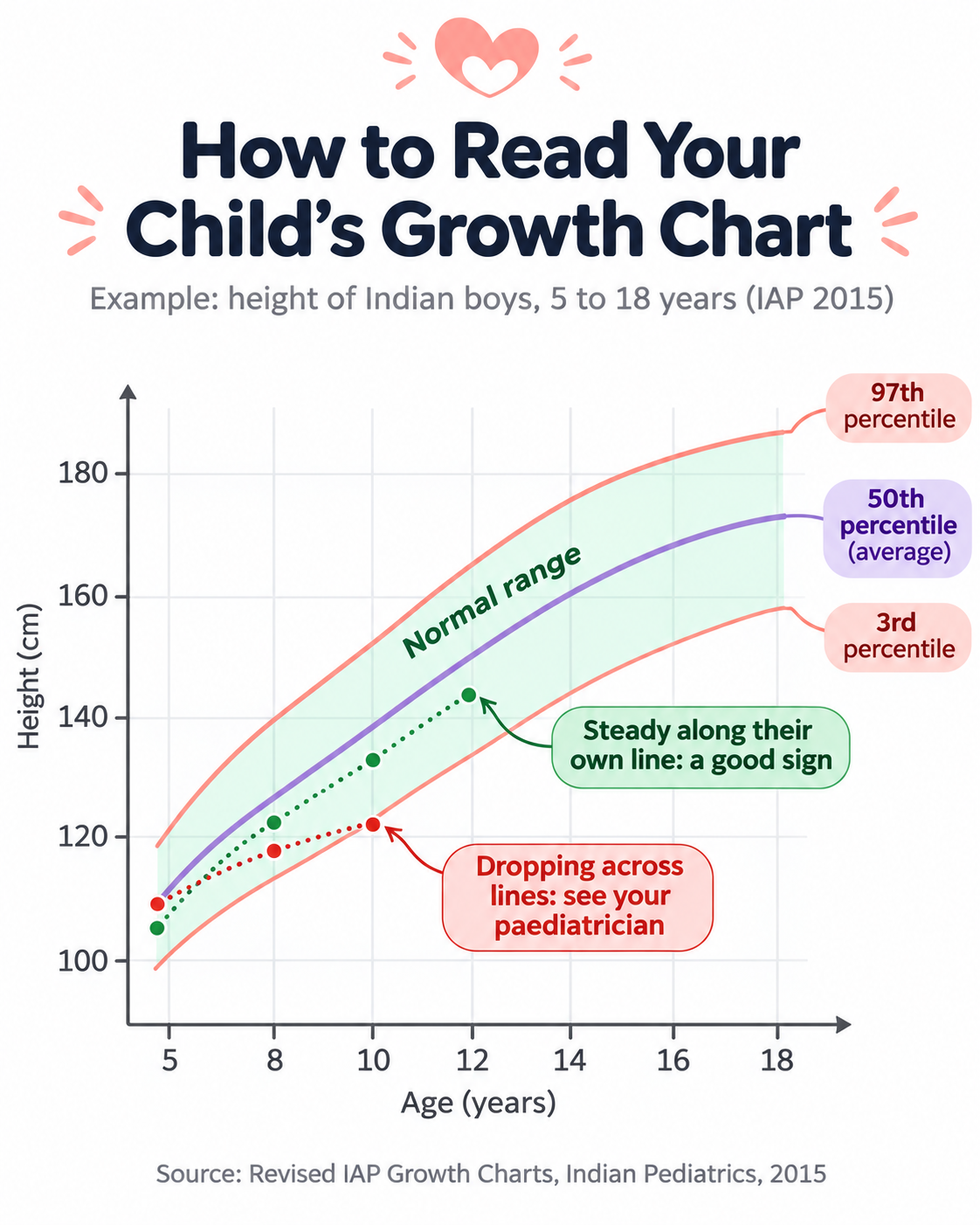
A percentile tells you how your child compares with 100 children of the same age and sex.
Percentile | What it means |
|---|---|
3rd | Only 3 out of 100 children are shorter or lighter |
50th | The middle: half of children are above and half below |
97th | Only 3 out of 100 children are taller or heavier |
Being on the 25th percentile is not "failing", and being on the 90th is not "better". A review of growth charts for Indian children explains that measurements plotted over a period of time are far more useful than a single height and weight record. A child who keeps growing steadily along the 25th percentile line is usually doing well.
Height and weight chart for boys (3 to 18 years)
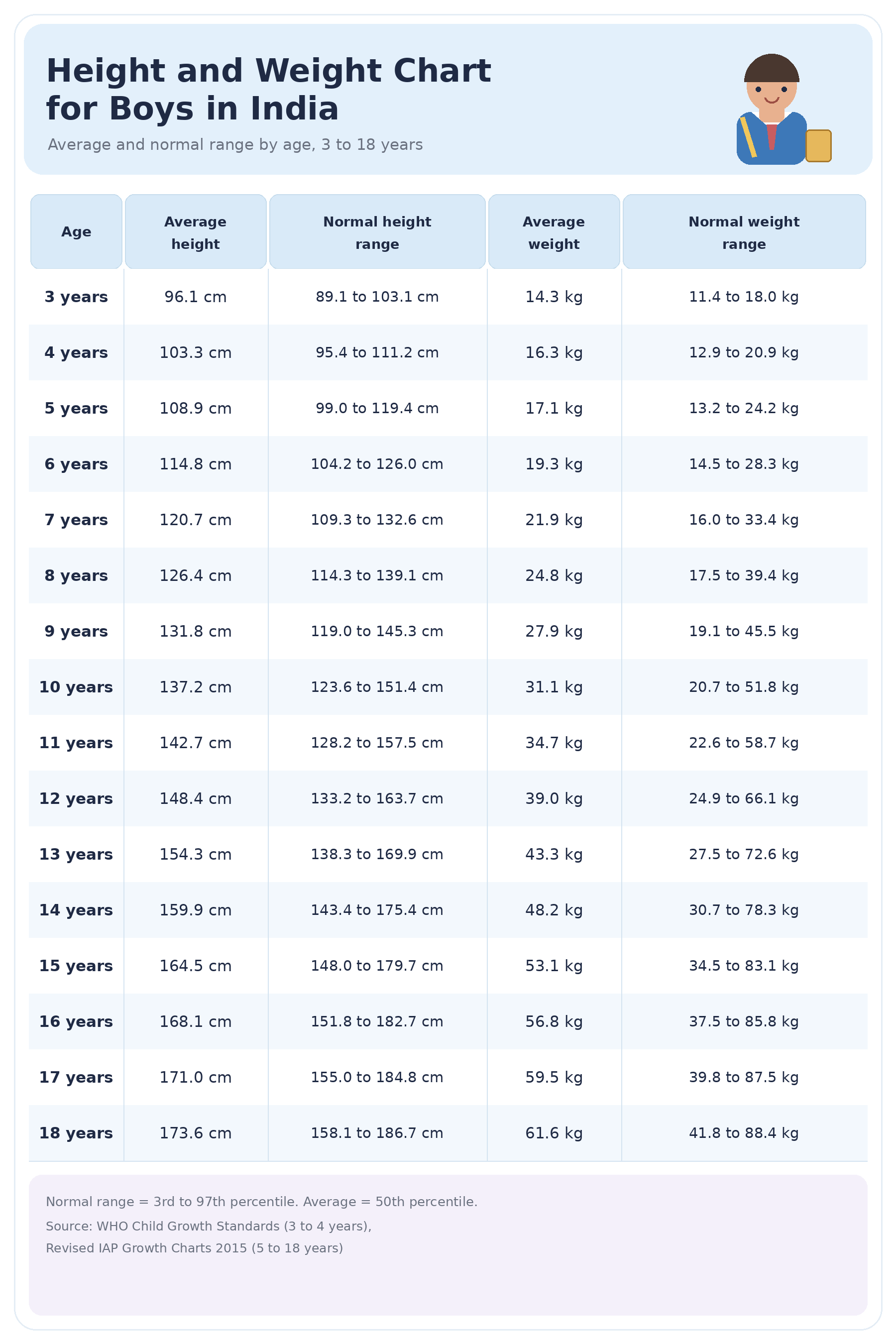
Ages 3 and 4 are from the WHO Child Growth Standards. Ages 5 to 18 are from the IAP 2015 charts.
Age | Height, 3rd percentile (cm) | Height, average (cm) | Height, 97th percentile (cm) | Weight, 3rd percentile (kg) | Weight, average (kg) | Weight, 97th percentile (kg) |
|---|---|---|---|---|---|---|
3 years | 89.1 | 96.1 | 103.1 | 11.4 | 14.3 | 18.0 |
4 years | 95.4 | 103.3 | 111.2 | 12.9 | 16.3 | 20.9 |
5 years | 99.0 | 108.9 | 119.4 | 13.2 | 17.1 | 24.2 |
6 years | 104.2 | 114.8 | 126.0 | 14.5 | 19.3 | 28.3 |
7 years | 109.3 | 120.7 | 132.6 | 16.0 | 21.9 | 33.4 |
8 years | 114.3 | 126.4 | 139.1 | 17.5 | 24.8 | 39.4 |
9 years | 119.0 | 131.8 | 145.3 | 19.1 | 27.9 | 45.5 |
10 years | 123.6 | 137.2 | 151.4 | 20.7 | 31.1 | 51.8 |
11 years | 128.2 | 142.7 | 157.5 | 22.6 | 34.7 | 58.7 |
12 years | 133.2 | 148.4 | 163.7 | 24.9 | 39.0 | 66.1 |
13 years | 138.3 | 154.3 | 169.9 | 27.5 | 43.3 | 72.6 |
14 years | 143.4 | 159.9 | 175.4 | 30.7 | 48.2 | 78.3 |
15 years | 148.0 | 164.5 | 179.7 | 34.5 | 53.1 | 83.1 |
16 years | 151.8 | 168.1 | 182.7 | 37.5 | 56.8 | 85.8 |
17 years | 155.0 | 171.0 | 184.8 | 39.8 | 59.5 | 87.5 |
18 years | 158.1 | 173.6 | 186.7 | 41.8 | 61.6 | 88.4 |
"Average" here is the 50th percentile.
Height and weight chart for girls (3 to 18 years)
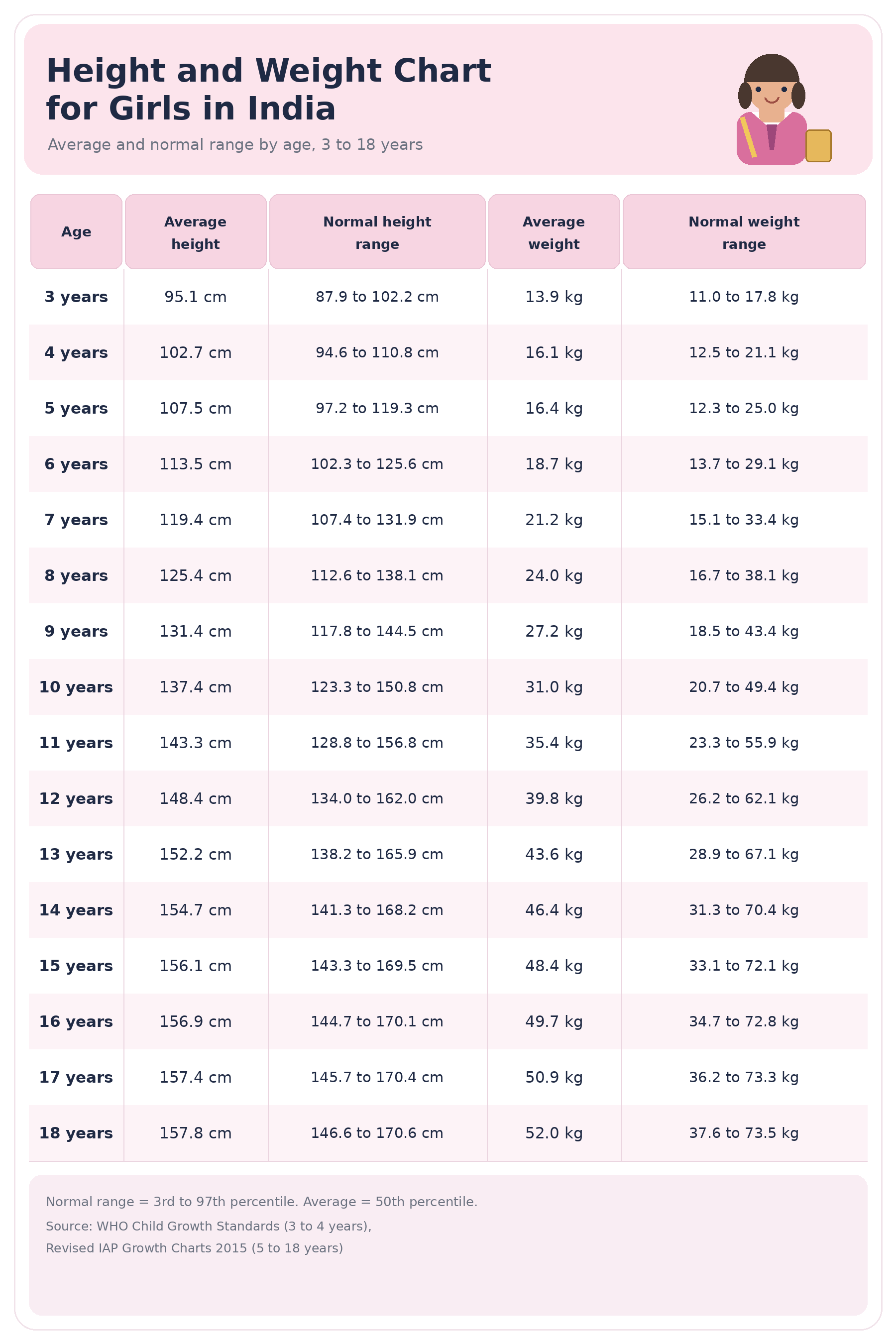
Ages 3 and 4 are from the WHO Child Growth Standards. Ages 5 to 18 are from the IAP 2015 charts.
Age | Height, 3rd percentile (cm) | Height, average (cm) | Height, 97th percentile (cm) | Weight, 3rd percentile (kg) | Weight, average (kg) | Weight, 97th percentile (kg) |
|---|---|---|---|---|---|---|
3 years | 87.9 | 95.1 | 102.2 | 11.0 | 13.9 | 17.8 |
4 years | 94.6 | 102.7 | 110.8 | 12.5 | 16.1 | 21.1 |
5 years | 97.2 | 107.5 | 119.3 | 12.3 | 16.4 | 25.0 |
6 years | 102.3 | 113.5 | 125.6 | 13.7 | 18.7 | 29.1 |
7 years | 107.4 | 119.4 | 131.9 | 15.1 | 21.2 | 33.4 |
8 years | 112.6 | 125.4 | 138.1 | 16.7 | 24.0 | 38.1 |
9 years | 117.8 | 131.4 | 144.5 | 18.5 | 27.2 | 43.4 |
10 years | 123.3 | 137.4 | 150.8 | 20.7 | 31.0 | 49.4 |
11 years | 128.8 | 143.3 | 156.8 | 23.3 | 35.4 | 55.9 |
12 years | 134.0 | 148.4 | 162.0 | 26.2 | 39.8 | 62.1 |
13 years | 138.2 | 152.2 | 165.9 | 28.9 | 43.6 | 67.1 |
14 years | 141.3 | 154.7 | 168.2 | 31.3 | 46.4 | 70.4 |
15 years | 143.3 | 156.1 | 169.5 | 33.1 | 48.4 | 72.1 |
16 years | 144.7 | 156.9 | 170.1 | 34.7 | 49.7 | 72.8 |
17 years | 145.7 | 157.4 | 170.4 | 36.2 | 50.9 | 73.3 |
18 years | 146.6 | 157.8 | 170.6 | 37.6 | 52.0 | 73.5 |
You may notice a small jump between 4 and 5 years. That is because the two rows come from different charts (WHO and IAP), not because children grow suddenly at 5.
Is your child younger than 3?
For babies and toddlers, see our month-by-month charts:
Is my child's weight healthy for their height?
Weight alone can mislead, because a tall child will naturally weigh more. For children aged 5 to 18, the IAP uses BMI (body mass index) charts, which compare weight with height. The IAP marks two lines on these charts, called the "adult equivalent of 23" and "adult equivalent of 27", to define overweight and obesity in Indian children.
At the other end, the WHO uses the 3rd percentile as the cut off for underweight and stunting (short for age). The review of Indian growth charts notes that WHO charts may over diagnose underweight and stunting in many apparently normal Indian children, which is one reason IAP charts are used from 5 years. Your paediatrician will work out your child's BMI and tell you which chart applies.
What affects a child's height and weight?
Genes: tall parents tend to have taller children, and petite parents smaller ones. This is the biggest factor in height.
Food: regular, balanced meals give a child what they need to reach their natural height and a healthy weight.
Sleep: good sleep is part of healthy growth, so keep a regular bedtime.
Illness: frequent infections, worms, or long-term conditions that affect eating or the absorption of food can slow growth.
Hormones: problems such as low thyroid or low growth hormone can slow growth and need a doctor's diagnosis.
Long-term medicines: some medicines, such as long courses of steroids, can affect growth. Never stop a prescribed medicine yourself; ask your doctor.
My child is a poor eater and growing slowly. What can I do?
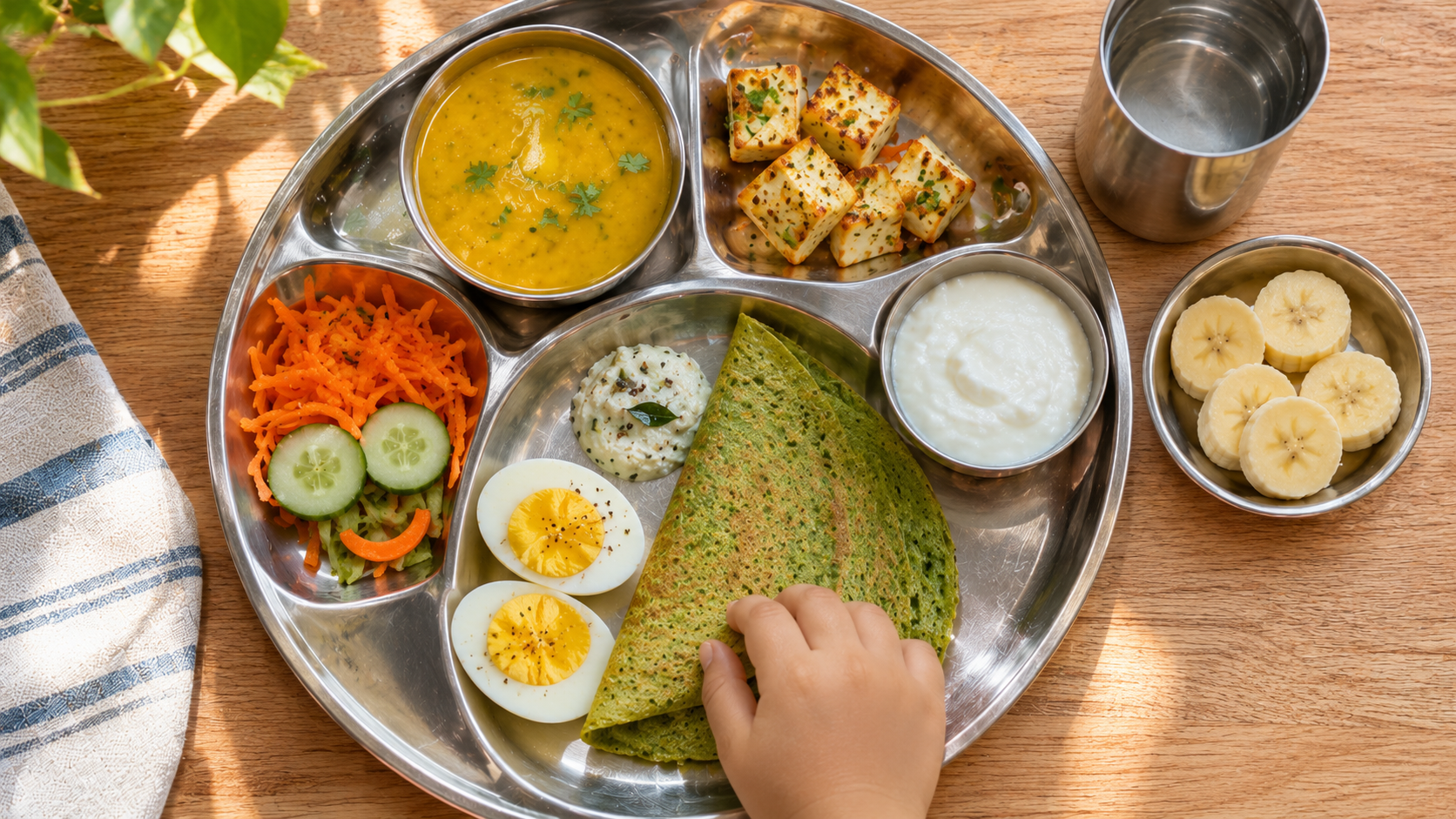
Picky eating is very common, and it does not always mean a child is not growing. The NHS says that if your child is active and gaining weight, and seems well, they are getting enough to eat. It also suggests looking at what your child eats over a week rather than in a single day.
Tips from the NHS and the American Academy of Pediatrics that work for Indian families:
Eat together, without screens. Switch off the TV and phones at mealtimes. Children learn to eat new foods by copying you.
Serve one family meal. Give your child the same dal, sabzi and roti or rice as everyone else, with at least one food they already like on the plate. Avoid cooking a separate meal every time they refuse.
Do not force, bribe or punish. The AAP says pressuring children to eat, or punishing them if they don't, can make them dislike foods they might otherwise like. Avoid rewarding with sweets or chocolate.
Keep offering. It can take 10 or more tastes before a child accepts a new food. Offer small amounts and try again after a week or two.
Change how you serve it. A child who refuses cooked carrots may enjoy them grated raw in a salad, or palak blended into a paratha or dosa batter.
Limit snacks and drinks between meals. The NHS says 2 healthy snacks a day is plenty. Too many biscuits, chips or juice fill a small stomach before mealtime.
Do not wait until they are too tired or hungry. Keep meal and snack times regular.
Add energy and protein to everyday foods. Ghee on roti, peanut or til chutney, paneer, curd, eggs, dals, sprouts and milk-based dishes like kheer help a small appetite go further.
Involve them. Let your child wash vegetables, choose between two sabzis or help roll a roti.
If picky eating continues and your child is not gaining weight, talk to your paediatrician, who can check for any illness and suggest a diet plan.
When should you see a paediatrician?
See your child's doctor if:
your child's height or weight is below the 3rd percentile or above the 97th percentile
your child's measurements drop to a lower percentile line over a few months, or their growth seems to have stopped
your child has lost weight, or has not gained weight for several months
your child eats very little, or only a few foods, and seems tired, weak or often unwell
your child is much shorter than other family members would suggest
your child has frequent diarrhoea, tummy pain, or other ongoing symptoms along with poor growth
Take any old height and weight records, school health cards or your child's vaccination card to the appointment. Previous readings help the doctor see the pattern.
Myths vs facts
Myth | Fact |
|---|---|
A thin child is an unhealthy child | Many children are naturally slim. Steady growth along their own percentile line matters more than looks |
My child should match the average in the chart | Anywhere between the 3rd and 97th percentile can be normal |
Force-feeding will make my child grow faster | The AAP says pressuring children to eat can make them dislike foods. Calm, regular meals work better |
A chubby child is a healthy child | Too much weight for height can lead to health problems. Ask your doctor to check BMI |
Western charts are right for Indian children | IAP recommends WHO charts under 5 years and IAP charts for 5 to 18 years |
Frequently Asked Questions
1. What is the normal weight for a 4-year-old in India? On the WHO charts, the average 4-year-old boy weighs about 16.3 kg and the average girl about 16.1 kg. The normal range is wide, from about 12.9 to 20.9 kg for boys and 12.5 to 21.1 kg for girls.
2. What is the average height of a 6-year-old Indian child? On the IAP 2015 charts, the average 6-year-old boy is about 114.8 cm tall and the average girl about 113.5 cm.
3. Will eating more make my child taller? Height depends mostly on genes. Good, balanced food helps a child reach their natural height, but extra food beyond their needs adds weight, not height.
4. My child is below the average. Should I worry? Not if they are above the 3rd percentile and growing steadily over time. If they are below the 3rd percentile, or dropping across lines, see your paediatrician.
5. How often should I measure my child's height and weight? Follow your paediatrician's advice. Readings taken over time are more useful than a single one, so keep a record and use the same scale each time.
6. Why are boys and girls shown on separate charts? Boys and girls grow at different rates, especially around puberty, so each has its own chart.
7. Do Mylo charts replace my doctor's growth chart? No. Use these charts as a guide. Your paediatrician's chart, with your child's readings plotted over time, is the most reliable record.
Related Articles
References
Khadilkar V, Yadav S, Agrawal KK, et al. Revised IAP growth charts for height, weight and body mass index for 5- to 18-year-old Indian children. Indian Pediatrics, 2015. https://www.indianpediatrics.net/jan2015/47.pdf (PubMed: https://pubmed.ncbi.nlm.nih.gov/25638185/)
World Health Organization. WHO Child Growth Standards: weight-for-age and length/height-for-age percentile tables. https://www.who.int/tools/child-growth-standards/standards
Khadilkar V, Khadilkar A. Growth charts: A diagnostic tool. Indian Journal of Endocrinology and Metabolism, 2011. https://pubmed.ncbi.nlm.nih.gov/22029020/
NHS. Fussy eaters. https://www.nhs.uk/conditions/baby/weaning-and-feeding/fussy-eaters/
American Academy of Pediatrics, HealthyChildren.org. 10 Tips for Parents of Picky Eaters. https://www.healthychildren.org/English/ages-stages/toddler/nutrition/Pages/Picky-Eaters.aspx
Medical disclaimer: This article is for general information only and is not a substitute for advice from your doctor. Please talk to your paediatrician about your child's growth.



Ask your question about general father
Get expert answers within 5 minutes for FREE only on Mylo App
Related Questions
Hi mommies, I'm a mother of 7 months 17 days old boy baby. My baby isn't crawling yet nor he hardly trying to sit this is putting me into anxiety. So can anyone help out in answering is this fine or is anything I have to do I'm putting him down on mat regularly encouraging him to sit putting toys to reach out all possible things. But my baby is active he started babbling he moves all around the mat n bed n eats well sitting in high chair etc but not doing these 2 things yet. Is there any mommie in the same boat? Help me out

Hi everyone.. Gud morning.. Please suggest me what to do. Actually I have sinus and during pregnancy it's very difficult to sleep aur unable to take breathe, I also consult doctor, can't help me out even steam se running nose control karna difficult hota h... If any suggestions please tell me. Thank you
Hi everyone! ❤️ I am 41 years old and pregnant again after 13 years! My oldest daughter is now a teenager. Because of my age and the long gap, I catch myself worrying a lot about the risk of birth defects, developmental issues, or something being wrong with the baby. I know many women have healthy pregnancies in their 40s, but the anxiety is definitely getting to me. For anyone who had a baby in their 40s: Did you have these same fears about birth defects, and how did you find peace of mind? What prenatal scans, blood tests, or checks helped reassure you that baby was developing normally? Is there anything specific you did—like vitamins, diet, or lifestyle adjustments—that gave you extra comfort? I would really appreciate hearing your experiences and any encouraging words. Thank you so much! 🙏

Posted In
General Father
75628 Posts
Related Articles

Watery Eyes in Babies: Blocked Tear Duct Causes, Care and When to See a Doctor

Second Baby Planning: How Long Should You Wait Between Pregnancies?

Baby Kidney Swelling on Ultrasound (Antenatal Hydronephrosis): Will It Go Away?

Foods for Height Growth in Toddlers and Kids: What Really Helps (Indian Guide)


AWARDS AND RECOGNITION

Mylo wins Forbes D2C Disruptor award

Mylo wins The Economic Times Promising Brands 2022
AS SEEN IN













- Mylo Care: Effective and science-backed personal care and wellness solutions for a joyful you.
- Mylo Baby: Science-backed, gentle and effective personal care & hygiene range for your little one.
- Mylo Community: Trusted and empathetic community of 10mn+ parents and experts.


