


Orders

Profile


Wallet


Pregnancy
2 months ago
Q: Mera satavan month chalu ho gaya hai kya khana hai bataiye
 3Answer


Quick Answer
The third trimester starts at week 28. Tiredness, poor sleep, heartburn, backache, swollen ankles, breathlessness and practice tightenings are common and usually normal. Reduced baby movements, bleeding, leaking fluid, severe headache or itchy palms need a doctor straight away. No symptom can tell you whether you are having a boy or a girl.
Welcome to the final stretch. If you feel heavier, more tired and a little unsure which aches are normal, you are not alone. This page is a quick symptom checklist: what most mothers feel now, what helps, and the signs that mean you should call your doctor instead of waiting.
For the full picture, including month-by-month changes, check-ups and getting ready for birth, read our complete guide to the third trimester of pregnancy.
Signs you have entered the third trimester
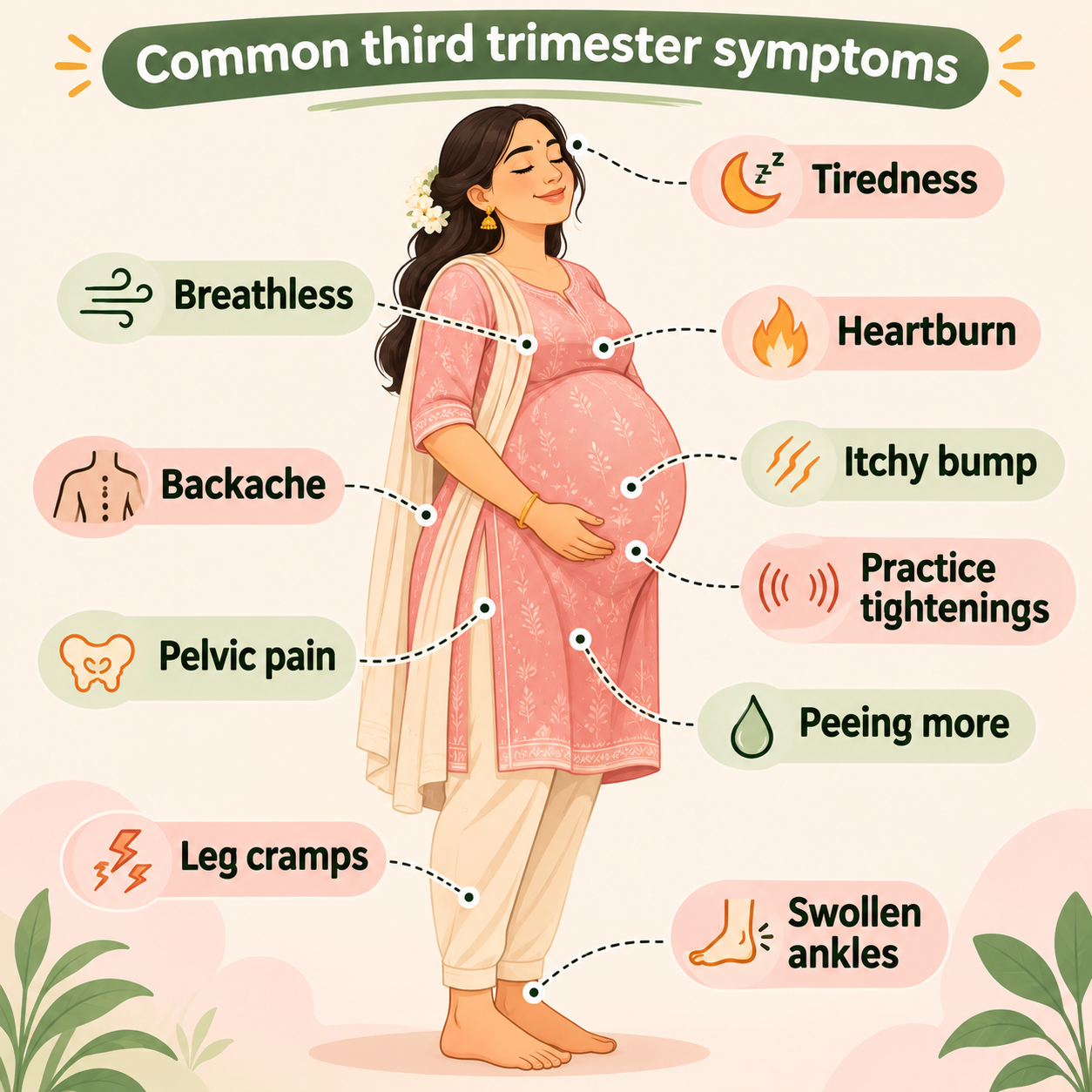
The third trimester is counted by weeks, not by symptoms. It begins at week 28 and lasts until your baby is born. Your due date and scan dates tell you where you are.
That said, many mothers notice that the body changes around this time. You may find that:
your baby's movements feel stronger, with more kicks, rolls and jerky movements [1]
you get irregular "practice" tightenings (Braxton Hicks) that come and go [2]
you feel tired again because of the extra weight you are carrying [3]
heartburn, breathlessness and needing to pee more often become part of daily life [4, 10, 6]
your back, pelvis and ankles feel the strain by evening [7, 8, 9]
None of these is a test. Some mothers have every one of them, and some have very few. Both are normal.
Third trimester symptoms: what is normal and what is a red flag
Symptom | Why it happens | What helps | Red flag: call your doctor |
|---|---|---|---|
Tiredness and exhaustion | The extra weight you are carrying, and broken sleep as the bump grows [3] | Rest with your feet up, accept help at home, keep up gentle activity such as a short walk | Feeling hopeless or losing interest in things you enjoy, which can be a sign of depression [3]. Ask whether your haemoglobin needs checking |
Trouble sleeping | Lying down gets uncomfortable and you need the toilet more [3] | Sleep on your side with a pillow under the bump and between the knees. Avoid late naps and evening tea or coffee [3] | Sleeplessness with low mood that does not lift [3] |
Heartburn and feeling full quickly | Hormones relax the valve at the top of the stomach and the baby presses on it [4] | Small, frequent meals. Sit upright while and after eating. Do not eat within 3 hours of bed. Prop up your head and shoulders [4] | Heartburn that does not settle with an antacid, especially with headache or swelling, can be a sign of pre-eclampsia [9] |
Backache | Ligaments soften to prepare for labour, straining the lower back and pelvis [7] | Bend your knees to lift, wear flat shoes, rest, try a warm bath or gentle massage [7] | Back pain in the third trimester can be a sign of early labour. Also call for back pain with fever, bleeding or pain when peeing. Loss of feeling in the legs or bottom is an emergency [7] |
Pelvic pain | Pelvic joints stiffen or move unevenly (pelvic girdle pain) [8] | Pillow between the legs in bed, sit down to dress, keep knees together getting into a car [8] | Pain that makes walking, stairs or turning in bed hard. Ask about physiotherapy [8] |
Swollen feet and ankles | Your body holds more water, and the womb affects blood flow in the legs [9] | Avoid standing for long, put your feet up, wear comfortable shoes, do foot exercises [9] | Sudden swelling of the face, hands or feet [9] |
Needing to pee a lot, small leaks | The baby's head presses on the bladder, and pelvic floor muscles relax [6] | Pelvic floor exercises. Cut down drinks late in the evening but drink well during the day [6] | Pain or burning when peeing, or blood in the urine, can mean an infection. See your doctor within 24 hours [6] |
Leg cramps | Common at night, usually in the calves [6] | Foot exercises, and pull your toes up towards your ankle during a cramp [6] | Sudden swelling in a leg, especially with pain, which can be a blood clot (DVT) [10] |
Breathlessness | Common as your baby grows [10] | Slow down, sit upright, take breaks on stairs | Breathlessness that comes on suddenly, happens when lying down, or comes with chest pain or dizziness [10] |
Constipation and piles | Hormone changes slow the bowel. Straining can cause piles [6, 11] | Fibre, water, regular activity, do not strain, a cold compress for sore piles [11] | Do not use any cream without asking your doctor first [11] |
Itchy skin and stretch marks | Hormones and stretching skin [12] | Unperfumed moisturiser, cool showers, loose cotton clothes, pat instead of scratching [12] | Intense itching on the palms or soles, itching worse at night, or itching that keeps you awake. This can be a liver condition (ICP) [12] |
More vaginal discharge | Normal, and it increases towards the end. A pink, jelly-like "show" can appear near labour [13] | Wear cotton underwear | Discharge that smells, is green or yellow, or itches. Any bleeding or fluid leak [13] |
Braxton Hicks tightenings | Practice tightenings that are usually painless, short and irregular [2] | Rest or change position | Tightenings that become regular and stronger, especially before 37 weeks [2] |
Feeling hot and sweaty | Hormones and more blood flow to the skin [6] | Loose natural fabrics, a fan, frequent baths [6] | A temperature of 38C or above, or shivering [10] |
To keep stretching skin on your bump soft, a gentle moisturiser such as Stretch Marks Cream - 100 gm can be part of your routine. The NHS notes there is limited evidence that any cream prevents stretch marks, so think of it as comfort care [14]. For tired, aching legs and back, a gentle massage with Pregnancy Massage Oil + Coconut Oil - 200 ml each can help you relax. Stop any product that irritates your skin.
For more on aches, see our guide to back pain during pregnancy.
Why am I so tired in the third trimester?
Many mothers are surprised that tiredness returns in the last months. The NHS explains that later in pregnancy you may feel tired because of the extra weight you are carrying, and a bigger bump makes a good night's sleep harder [3].
Feeling tired does not harm you or your baby [3]. What helps:
Rest whenever you can, and say yes to help with cooking, older children or housework.
Keep moving gently. Exercise can help you feel less tired [3].
Go to sleep on your side. After 28 weeks, falling asleep on your back has been linked to a higher risk of stillbirth. If you wake up on your back, just turn over [3].
Avoid tea, coffee or cola in the evening, and long naps late in the day [3].
Mention exhaustion at your next check-up, especially if you also feel breathless, dizzy or very low. Your doctor may want to check for anaemia or talk about your mood.
Are there baby boy symptoms in the third trimester?
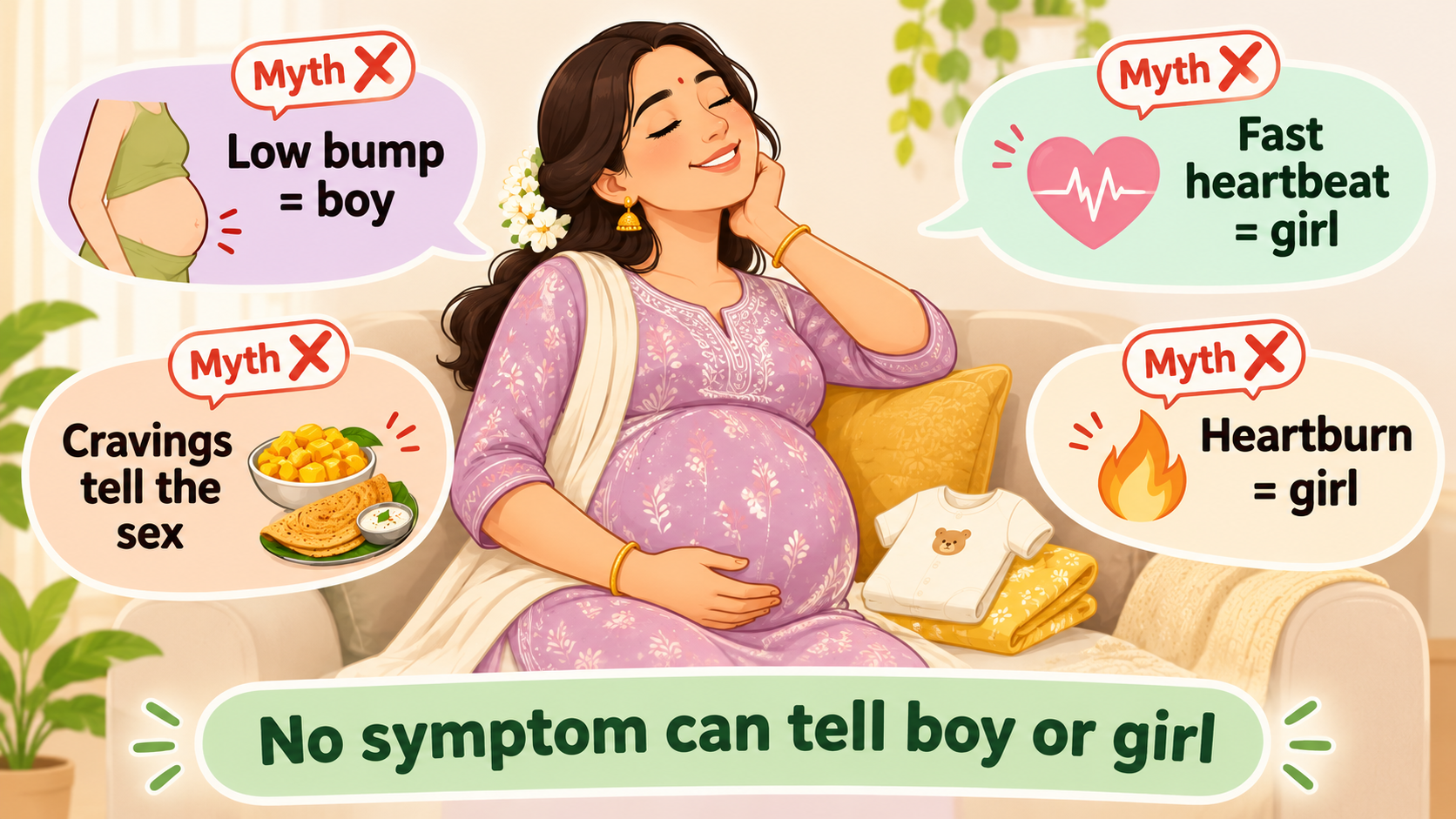
No. There are no third trimester symptoms of a baby boy, and no symptoms of a baby girl either. This is one of the most searched questions about the third trimester, so here is what research actually shows.
Bump shape does not predict sex. A Johns Hopkins study of 104 pregnant women found that fetal sex was not related to the shape of the bump, morning sickness, or how the pregnancy compared with earlier ones. Overall, women were not good predictors of their baby's sex [15].
Heart rate does not predict sex. A study of 477 pregnancies found no significant difference between the heart rates of boys and girls in the first trimester [16].
Heartburn does not predict sex. In a small study, heartburn severity was not linked to the baby's sex. Interestingly, mothers with more heartburn did tend to have babies with more hair [17].
Boy or girl signs: myths vs facts
Myth | Fact |
|---|---|
A low or pointed bump means a boy | Bump shape was not related to the baby's sex in research [15]. It depends on your muscles, body shape and your baby's position |
Craving salty or sour food means a boy, sweets mean a girl | There is no good evidence that cravings predict sex |
Lots of heartburn means a girl | Heartburn severity was not linked to sex. One small study found it was linked to more newborn hair [17] |
A fast heartbeat means a girl | No significant difference was found between boys' and girls' heart rates [16] |
Glowing skin means a boy, acne or dark patches mean a girl | Skin changes in pregnancy come from hormones and affect mothers of boys and girls [6] |
"This pregnancy feels different from my last one, so it must be the other sex" | Comparing with previous pregnancies did not predict sex [15]. Every pregnancy is different |
Finding out the baby's sex before birth is illegal in India. Under the Pre-Conception and Pre-Natal Diagnostic Techniques (PC&PNDT) Act, 1994, sex determination is prohibited, and no one, including the person doing a scan, may tell a pregnant woman or her relatives the sex of the baby by words, signs or any other means [18]. Your scans are for checking your baby's growth and health.
Boy or girl, your baby needs the same things from you now: rest, good food, your check-ups and your attention to their movements.
Third pregnancy: are the symptoms different?
If this is your third baby, the third trimester can feel familiar and different at the same time. A few things the evidence supports:
You may have felt movements earlier. The NHS notes that first-time mothers might not feel movements until after 20 weeks, so you may have noticed them earlier this time [1].
Heartburn may be more likely. The NHS lists having been pregnant before as one reason indigestion is more likely [4].
Labour is often quicker. In a first pregnancy, established labour to full dilation usually takes 8 to 18 hours. In a second or third pregnancy it is often around 5 to 12 hours [19]. Plan your hospital travel and childcare early.
A long gap matters. If it has been 10 years or more since your last pregnancy, your risk of pre-eclampsia is higher, so do not skip blood pressure checks [20].
Tiredness can feel heavier when you are also caring for older children. Ask for help early.
Do not assume that a symptom is fine because you had it last time. The red flags below apply to every pregnancy, first or fifth.
If you searched "3rd pregnancy symptoms" because you think you may be pregnant again, the early signs are the same as in any pregnancy. A home pregnancy test and a visit to your doctor will confirm it.
When should you see a doctor?
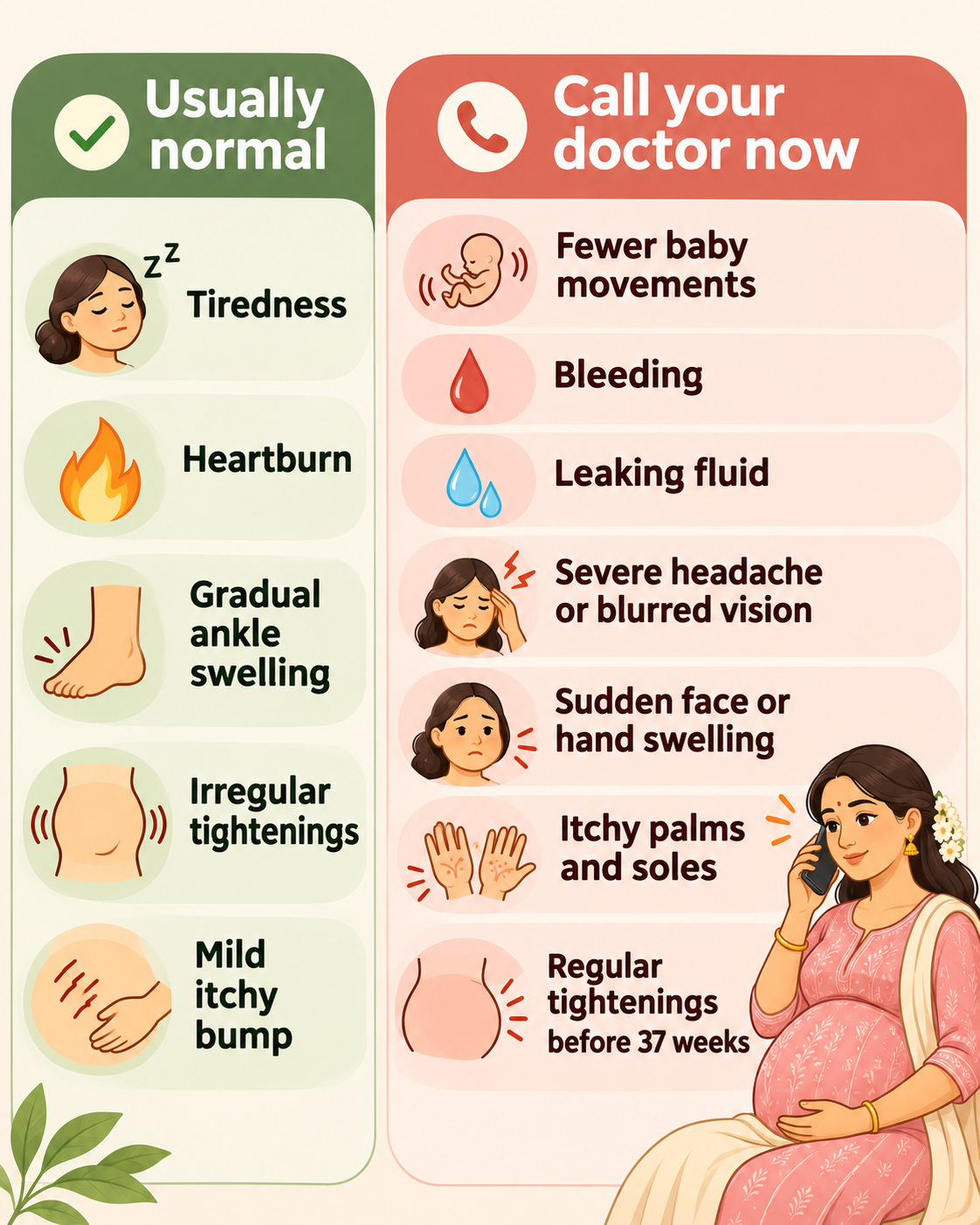
Call your doctor or go to the hospital straight away, day or night, if you have:
Reduced or changed baby movements, or you cannot feel your baby moving. Do not wait until the next day, even in the middle of the night. Do not use a home doppler to reassure yourself [1]
Any vaginal bleeding [10, 13]
Fluid leaking from the vagina, as a gush or a trickle, especially if it is coloured or smells [2, 10]
Regular tightenings or contractions before 37 weeks, or if you think you might be in labour early [2]
A severe headache, blurred vision or flashing lights, pain just below the ribs, vomiting, or sudden swelling of the face, hands or feet. These can be signs of pre-eclampsia [5, 9, 20]
Chest pain, sudden breathlessness, or breathlessness when lying down [10]
Intense itching of the palms and soles, or itching that is worse at night [12]
A temperature of 38C or above [10]
Sudden swelling in one leg, especially with pain [10]
Back pain with loss of feeling in the legs, bottom or genitals [7]
Trust your instincts. If something feels wrong, get checked. See our guide on when to make an emergency doctor visit during pregnancy, and for everyday headaches, natural ways to ease a headache during pregnancy.
Frequently Asked Questions
1. When does the third trimester start? At week 28, and it lasts until your baby is born. It covers roughly the seventh, eighth and ninth months.
2. Is extreme tiredness normal in the third trimester? Yes, it is common because of the extra weight you carry and poorer sleep. Rest, gentle activity and side sleeping help. Tell your doctor if tiredness comes with breathlessness, dizziness or low mood.
3. Are there baby boy or baby girl symptoms in the third trimester? No. Research has found that bump shape, heart rate, heartburn and comparisons with earlier pregnancies do not predict the baby's sex.
4. Can a doctor tell me the baby's sex in India? No. Sex determination and revealing the baby's sex before birth are illegal under the PC&PNDT Act, 1994.
5. Are third pregnancy symptoms different from the first? Often a little. Heartburn may be more likely and labour is often quicker. Warning signs are the same in every pregnancy.
6. Why can't I sleep in the third trimester? A bigger bump, needing the toilet and heartburn all disturb sleep. Try side sleeping with pillows, no late naps, no evening caffeine and small dinners eaten well before bed.
7. Which third trimester symptoms mean I should go to hospital? Reduced movements, bleeding, leaking fluid, regular tightenings before 37 weeks, severe headache or vision changes, sudden swelling, chest pain and intense itching of the palms and soles.
Related Articles
References
NHS. Your baby's movements. https://www.nhs.uk/pregnancy/keeping-well/your-babys-movements/
NHS. Signs that labour has begun. https://www.nhs.uk/pregnancy/labour-and-birth/signs-of-labour/signs-that-labour-has-begun/
NHS. Tiredness and sleep problems in pregnancy. https://www.nhs.uk/pregnancy/common-symptoms/tiredness/
NHS. Indigestion and heartburn in pregnancy. https://www.nhs.uk/pregnancy/common-symptoms/indigestion-and-heartburn/
NHS. Headaches in pregnancy. https://www.nhs.uk/pregnancy/common-symptoms/headaches/
NHS. Common health problems in pregnancy. https://www.nhs.uk/pregnancy/common-symptoms/common-health-problems/
NHS. Back pain in pregnancy. https://www.nhs.uk/pregnancy/common-symptoms/back-pain/
NHS. Pelvic pain in pregnancy. https://www.nhs.uk/pregnancy/common-symptoms/pelvic-pain/
NHS. Swollen ankles, feet and fingers in pregnancy. https://www.nhs.uk/pregnancy/common-symptoms/swollen-ankles-feet-and-fingers/
NHS. Pregnancy symptoms you need to get help for. https://www.nhs.uk/pregnancy/common-symptoms/pregnancy-symptoms-you-need-to-get-help-for/
NHS. Piles in pregnancy. https://www.nhs.uk/pregnancy/common-symptoms/piles/
NHS. Itching and intrahepatic cholestasis of pregnancy. https://www.nhs.uk/pregnancy/complications/itching-and-intrahepatic-cholestasis/
NHS. Vaginal discharge in pregnancy. https://www.nhs.uk/pregnancy/common-symptoms/vaginal-discharge/
NHS. Stretch marks in pregnancy. https://www.nhs.uk/pregnancy/common-symptoms/stretch-marks/
Perry DF, DiPietro J, Costigan K. Are women carrying "basketballs" really having boys? Testing pregnancy folklore. Birth. 1999;26(3):172-7. PMID: 10655817. https://pubmed.ncbi.nlm.nih.gov/10655817/
McKenna DS, Ventolini G, Neiger R, Downing C. Gender-related differences in fetal heart rate during first trimester. Fetal Diagnosis and Therapy. 2006;21(1):144-7. PMID: 16354993. https://pubmed.ncbi.nlm.nih.gov/16354993/
Costigan KA, Sipsma HL, DiPietro JA. Pregnancy folklore revisited: the case of heartburn and hair. Birth. 2006;33(4):311-4. PMID: 17150070. https://pubmed.ncbi.nlm.nih.gov/17150070/
Government of India. The Pre-Conception and Pre-Natal Diagnostic Techniques (Prohibition of Sex Selection) Act, 1994. https://www.py.gov.in/sites/default/files/pre-conception-pre-natal-diagnostic-techniquest-act1994.pdf
NHS. The stages of labour and birth. https://www.nhs.uk/pregnancy/labour-and-birth/what-happens/the-stages-of-labour-and-birth/
NHS. Pre-eclampsia. https://www.nhs.uk/conditions/pre-eclampsia/
Medical disclaimer: This article is for general information only and is not a substitute for advice from your doctor. Go to the hospital immediately for reduced baby movements, bleeding, leaking fluid, contractions before 37 weeks, severe headache with vision changes, or sudden swelling of the face and hands.

Read More Answers (1)


Ask your question about pregnancy
Get expert answers within 5 minutes for FREE only on Mylo App
Related Questions
meri beti 4 month ki hai..to use bottel se dudh kabse chalu karu..abhi to wo bottel ka nippal muh me nahi leti jibh se bahar fekti hai

Hello Mera 9 month lga hai.. Due date 21 july hai.. But dr bol rhi baby ulta hai so 25 june ko operation krna pdega.. Baby ulta hone ka kya mtlb hai. And koi teika hai baby ke sidhe hone ka ?
Bp kam Karne ke liye Kya khana chahiye please mujhe bataiye
Posted In
Pregnancy
3789823 Posts
Related Articles



Related Topics


AWARDS AND RECOGNITION

Mylo wins Forbes D2C Disruptor award

Mylo wins The Economic Times Promising Brands 2022
AS SEEN IN













- Mylo Care: Effective and science-backed personal care and wellness solutions for a joyful you.
- Mylo Baby: Science-backed, gentle and effective personal care & hygiene range for your little one.
- Mylo Community: Trusted and empathetic community of 10mn+ parents and experts.


