


Baby Care
2 days ago
Q: Meri Beti 11 mhine ki ho fyi ho gyi he or uska weight 7 kg he to sahi ya Kam he please bataiye
 6Answer


TL;DR
Most babies weigh about 3.2 to 3.3 kg at birth, roughly double that by about 4 months, and nearly triple it by 12 months. The WHO chart below shows the average and the normal range for every month. A baby inside the range who is growing steadily is usually fine. A baby below the range, or one whose weight stops rising, should be checked by a paediatrician.
Quick Answer
The WHO average weight for girls is 6.4 kg at 4 months and 8.9 kg at 12 months; for boys it is 7.0 kg and 9.6 kg. The normal range is wide, for example 5.0 to 8.2 kg for a 4 month old girl. Below the lower value, or not gaining, see your paediatrician soon.
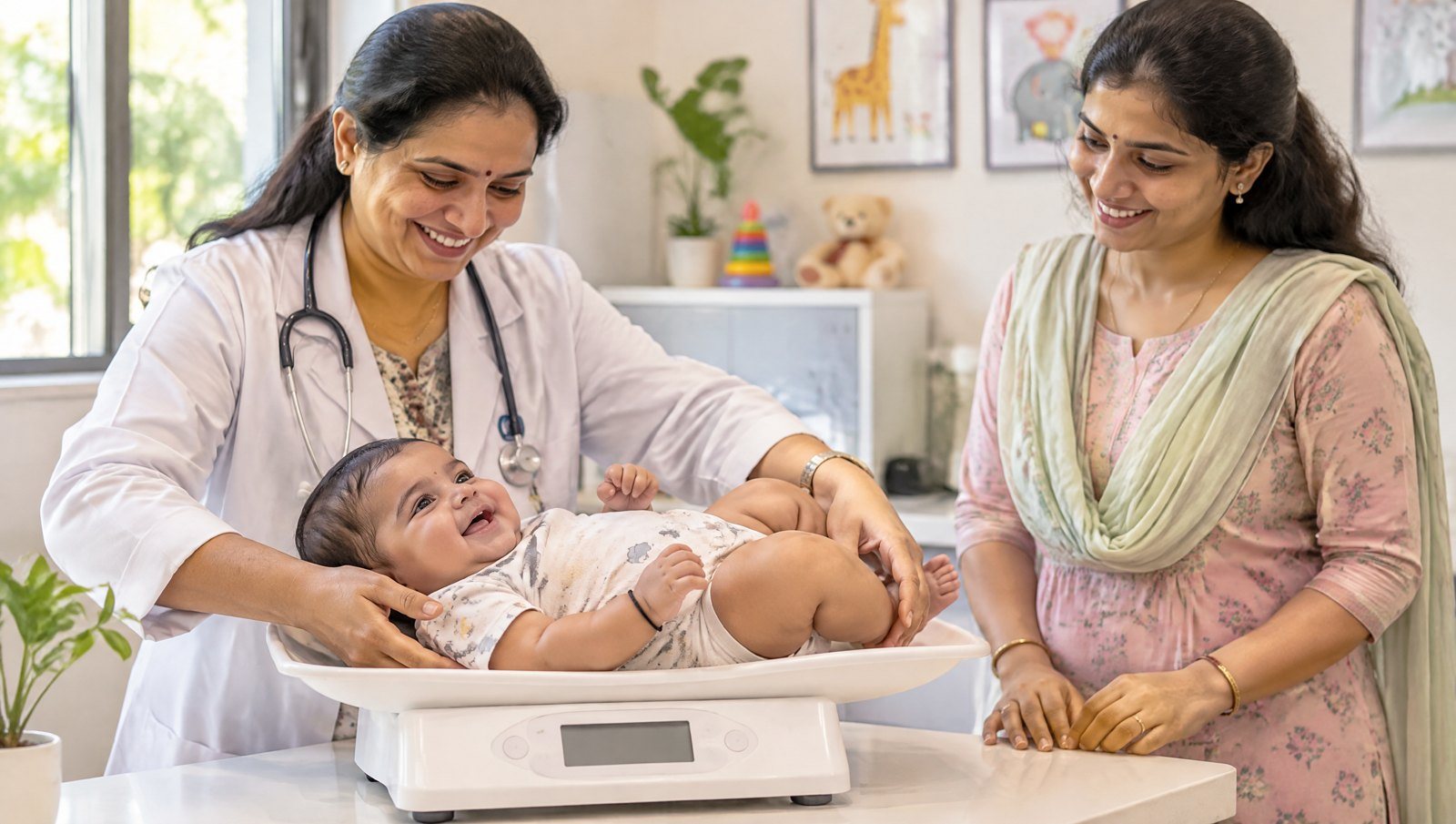
Weighing day can be nerve wracking, especially when relatives compare your baby with their own children or the number on the scale looks smaller than you expected. The good news is that healthy babies come in many sizes. What matters is whether your baby sits within the healthy range and keeps growing along their own curve. Use the charts below to see where your baby stands, and when to ask your doctor for a closer look.
Baby Weight Chart by Month (KG): 0 to 12 Months
The table shows the WHO Child Growth Standards for weight. The "lower" and "upper" columns are 2 standard deviations below and above the average, roughly the 2nd and 98th percentiles. About 95 out of 100 healthy babies fall between them (WHO, CDC WHO data tables).
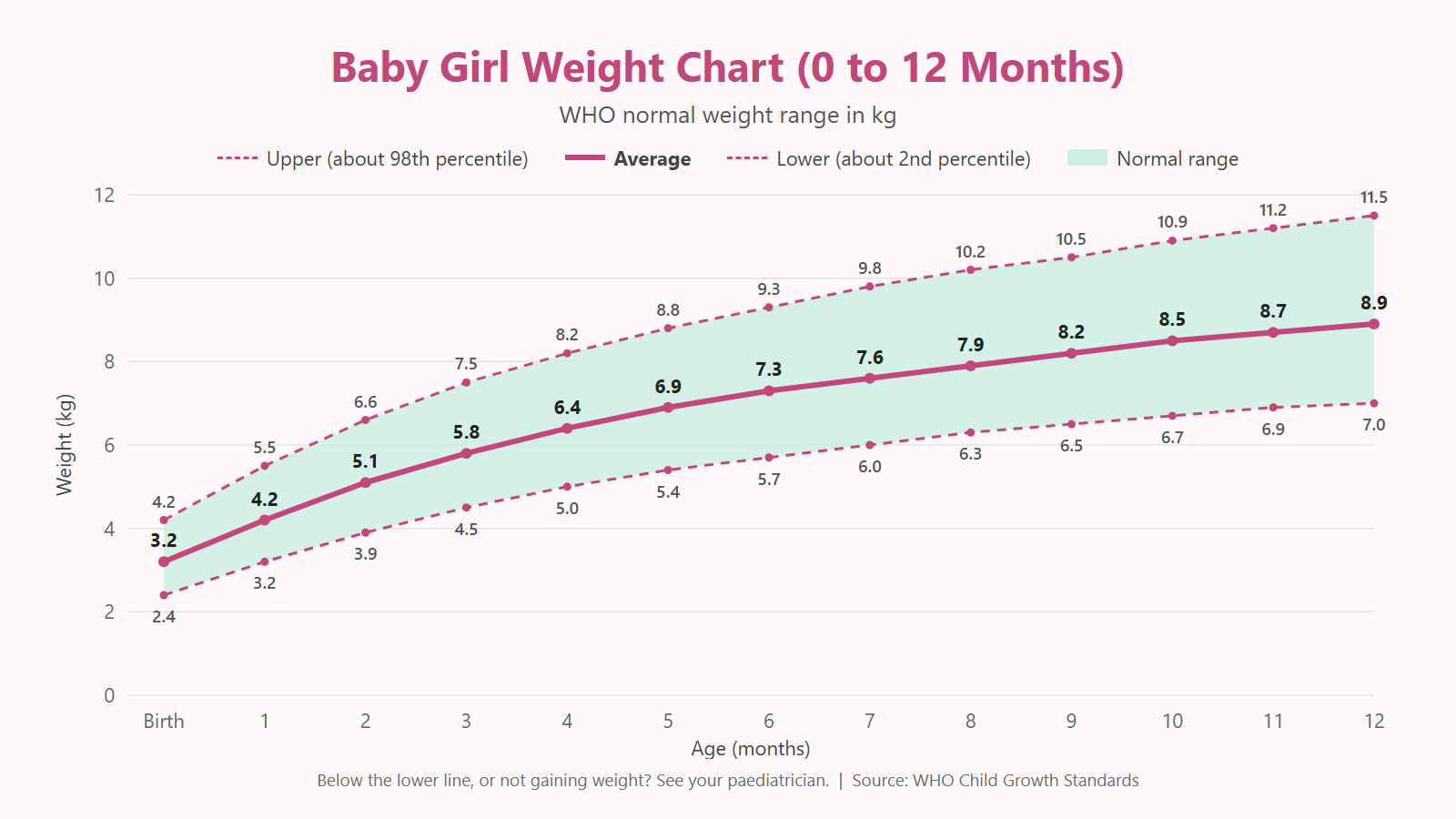
Girls weight chart (kg)
Age | Lower (about 2nd percentile) | Average (50th percentile) | Upper (about 98th percentile) |
|---|---|---|---|
Birth | 2.4 | 3.2 | 4.2 |
1 month | 3.2 | 4.2 | 5.5 |
2 months | 3.9 | 5.1 | 6.6 |
3 months | 4.5 | 5.8 | 7.5 |
4 months | 5.0 | 6.4 | 8.2 |
5 months | 5.4 | 6.9 | 8.8 |
6 months | 5.7 | 7.3 | 9.3 |
7 months | 6.0 | 7.6 | 9.8 |
8 months | 6.3 | 7.9 | 10.2 |
9 months | 6.5 | 8.2 | 10.5 |
10 months | 6.7 | 8.5 | 10.9 |
11 months | 6.9 | 8.7 | 11.2 |
12 months | 7.0 | 8.9 | 11.5 |
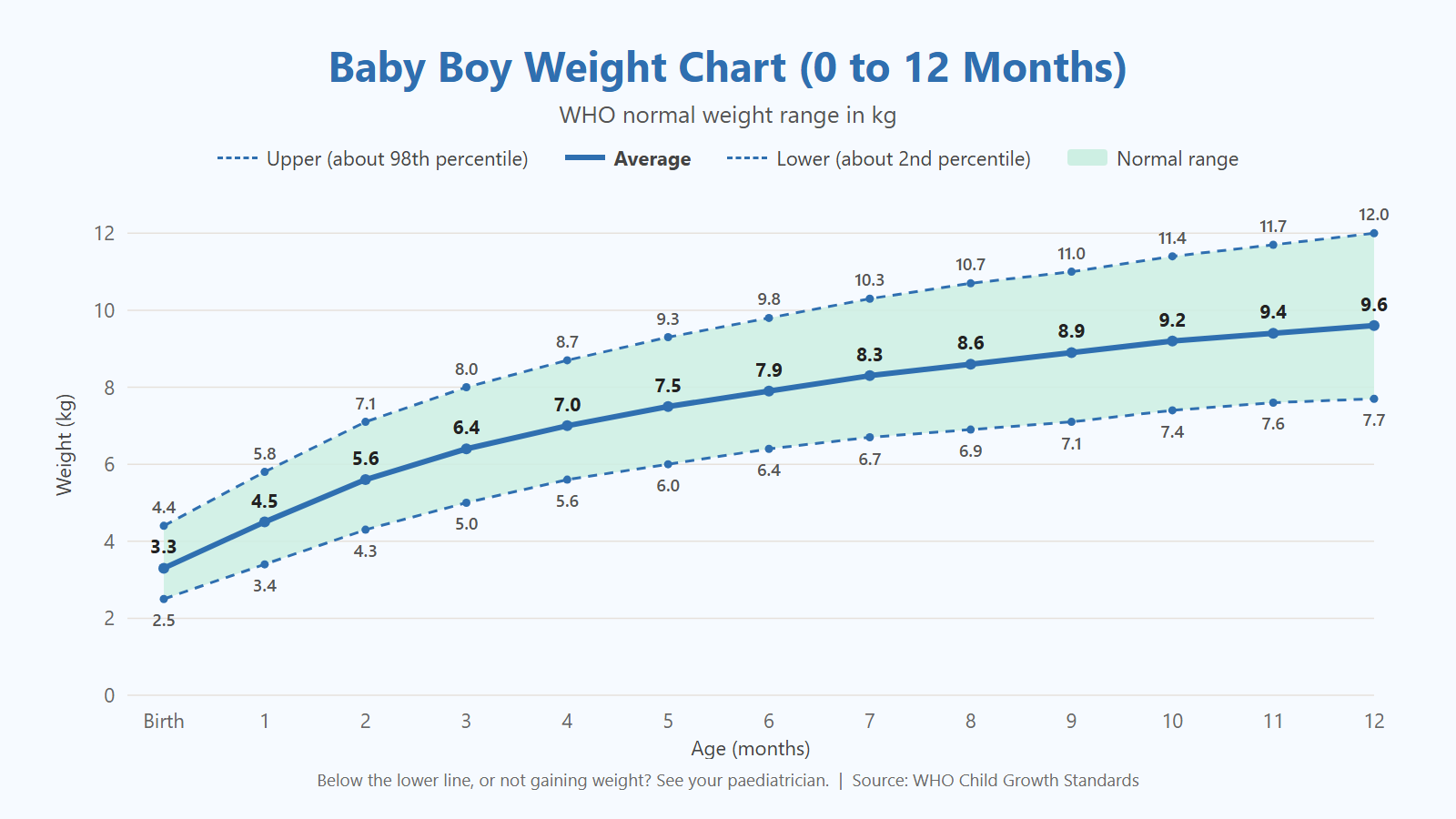
Boys weight chart (kg)
Age | Lower (about 2nd percentile) | Average (50th percentile) | Upper (about 98th percentile) |
|---|---|---|---|
Birth | 2.5 | 3.3 | 4.4 |
1 month | 3.4 | 4.5 | 5.8 |
2 months | 4.3 | 5.6 | 7.1 |
3 months | 5.0 | 6.4 | 8.0 |
4 months | 5.6 | 7.0 | 8.7 |
5 months | 6.0 | 7.5 | 9.3 |
6 months | 6.4 | 7.9 | 9.8 |
7 months | 6.7 | 8.3 | 10.3 |
8 months | 6.9 | 8.6 | 10.7 |
9 months | 7.1 | 8.9 | 11.0 |
10 months | 7.4 | 9.2 | 11.4 |
11 months | 7.6 | 9.4 | 11.7 |
12 months | 7.7 | 9.6 | 12.0 |
How to read this: the average is the middle line. Half of healthy babies weigh more and half weigh less, so being below the average is not a problem on its own. What matters is that your baby is within the range and keeps moving along their own line over time. If your baby is between two months of age, look at both rows. For example, a girl aged 4 and a half months would usually weigh somewhere between about 5.2 and 8.5 kg.
Baby Height (Length) Chart by Month: 0 to 12 Months
Length is measured lying down until 2 years of age. These WHO values show the average and the normal range (WHO, CDC WHO data tables).
Age | Girls: range (average), cm | Boys: range (average), cm |
|---|---|---|
Birth | 45.4 to 52.9 (49.1) | 46.1 to 53.7 (49.9) |
1 month | 49.8 to 57.6 (53.7) | 50.8 to 58.6 (54.7) |
2 months | 53.0 to 61.1 (57.1) | 54.4 to 62.4 (58.4) |
3 months | 55.6 to 64.0 (59.8) | 57.3 to 65.5 (61.4) |
4 months | 57.8 to 66.4 (62.1) | 59.7 to 68.0 (63.9) |
5 months | 59.6 to 68.5 (64.0) | 61.7 to 70.1 (65.9) |
6 months | 61.2 to 70.3 (65.7) | 63.3 to 71.9 (67.6) |
7 months | 62.7 to 71.9 (67.3) | 64.8 to 73.5 (69.2) |
8 months | 64.0 to 73.5 (68.7) | 66.2 to 75.0 (70.6) |
9 months | 65.3 to 75.0 (70.1) | 67.5 to 76.5 (72.0) |
10 months | 66.5 to 76.4 (71.5) | 68.7 to 77.9 (73.3) |
11 months | 67.7 to 77.8 (72.8) | 69.9 to 79.2 (74.5) |
12 months | 68.9 to 79.2 (74.0) | 71.0 to 80.5 (75.7) |
How much weight should a baby gain each month?
Babies grow fastest in the first 3 months and then slow down. Based on the WHO average lines, typical gains are roughly:
Age | Average gain (WHO average line) |
|---|---|
0 to 3 months | About 200 to 240 g a week (about 0.9 to 1 kg a month) |
3 to 6 months | About 115 g a week (about 0.5 kg a month) |
6 to 12 months | About 60 to 65 g a week (about 0.25 to 0.3 kg a month) |
These are averages worked out from the WHO tables, not targets. Healthy babies gain a little more or less, and gain often comes in spurts.
It is normal for babies to lose some weight in the first few days after birth. Putting on weight steadily after this is a sign your baby is healthy and feeding well, and most babies regain their birth weight within the first 3 weeks (NHS).
Key weight milestones: doubling and tripling
These milestones are a simple way to check that growth is on track.
Milestone | When it usually happens |
|---|---|
Regains birth weight | Within the first 2 to 3 weeks (NHS) |
Doubles birth weight | Around 4 months on the WHO average lines |
Nearly triples birth weight | Around 12 months on the WHO average lines |
A common myth is that babies double their weight by 7 months. On the WHO average lines, a girl goes from 3.2 kg at birth to 6.4 kg at 4 months, and a boy from 3.3 kg to 6.4 kg at 3 months and 7.0 kg at 4 months (WHO).
My baby is below the chart range. What should I do?
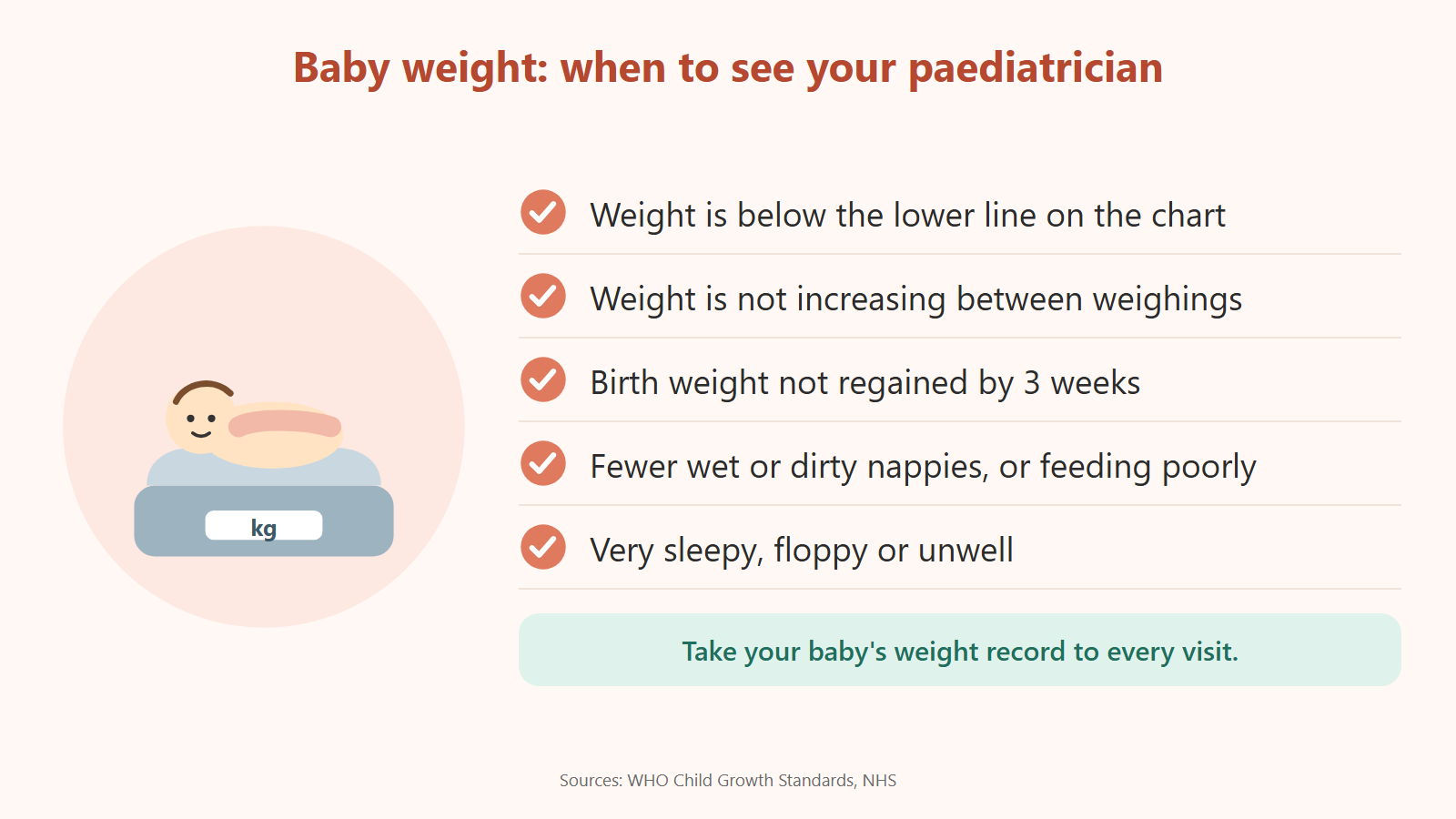
If your baby's weight is below the "lower" value for their age, please show your paediatrician soon, ideally within the next few days, and take your baby's weight record with you. This does not always mean something is wrong, but it does need a proper check.
Your doctor will usually:
plot all your baby's past weights on a growth chart to see the trend
consider birth weight, and whether your baby was born early (for premature babies, doctors use corrected age, counted from the due date)
check feeding, wet and dirty nappies, and any illness
measure length and head size, and examine your baby
For example, a girl aged 4 and a half months who weighs 4.5 kg is below the lower value for 4 months (5.0 kg). Her doctor will want to see her growth over time, how she is feeding, and whether she needs support.
What affects a baby's weight?
Many normal factors influence how much a baby weighs, so try not to compare your baby with others.
Factor | Effect |
|---|---|
Genes | Parents' build influences baby's size |
Birth weight and gestation | Premature or small babies often start smaller and follow their own curve |
Sex | Boys are usually slightly heavier than girls |
Feeding | Breastfed and formula fed babies can grow at slightly different rates |
Health | An illness can slow gain for a while |
The WHO standards were built from healthy breastfed babies, so they describe how babies grow when feeding and care are good (WHO).
When should you worry about your baby's weight?
See your paediatrician if:
your baby's weight is below the lower value in the chart above
your baby's weight is not increasing between weighings, or is falling across percentile lines
your baby has not regained birth weight by 3 weeks (NHS)
your baby has fewer wet or dirty nappies than usual, or is feeding poorly
your baby seems very sleepy, floppy or unwell
A single reading just inside the range is usually not a worry. A baby below the range, or one whose weight stops rising, needs a doctor to look at the full picture.
Indian context: what Indian parents should know
Which chart? For babies, Indian paediatricians use the WHO Child Growth Standards. The IAP (Indian Academy of Pediatrics) 2015 charts are made for children aged 5 to 18 years (IAP Growth Charts Committee, 2015). Your baby's clinic chart, plotted at each visit, is the real reference.
Use vaccination visits: ask for your baby to be weighed and plotted at each visit. You can track visit dates with Mylo's immunization scheduler.
Chubby is not always healthier: steady growth within the range matters more than a big number.
Feeding: WHO recommends exclusive breastfeeding for the first 6 months, with solids added from 6 months (WHO).
Baby weight: myths or facts?
Is a chubby baby the healthiest baby?
No. Steady growth within the healthy range matters more than being heavy.
Does my baby need to be on the average line?
No. Healthy babies can be anywhere within the range (WHO).
Do babies double their birth weight by 7 months?
No. On the WHO average lines, babies double their birth weight by about 4 months.
Is any weight fine as long as the baby seems happy?
No. A baby below the lower value, or one who is not gaining, should be checked by a doctor even if they seem content.
Will starting solids early help my baby gain weight?
No. Solids are recommended from 6 months, with exclusive breastfeeding before that (WHO).
FAQs: Baby Weight Chart 0 to 12 Months
What is the normal weight of a 4 month old baby girl?
On the WHO chart, the average is 6.4 kg, and the normal range is about 5.0 to 8.2 kg (WHO). If your daughter weighs less than 5.0 kg at 4 months, please show your paediatrician soon.
Bachche ka weight har mahine kitna hona chahiye? (Hinglish)
WHO chart ke hisaab se ladkiyon ka average weight 4 mahine par 6.4 kg aur 12 mahine par 8.9 kg hota hai, aur ladkon ka 7.0 kg aur 9.6 kg. Normal range kaafi wide hai, jaise 4 mahine ki ladki ke liye 5.0 se 8.2 kg. Agar baby ka weight range se kam hai ya badh nahi raha, to jaldi doctor ko dikhayein.
How much should a 3 month old baby weigh?
On average, about 5.8 kg for girls and 6.4 kg for boys. The normal range is about 4.5 to 7.5 kg for girls and 5.0 to 8.0 kg for boys (WHO).
Mera baby chart se halka hai, chinta ki baat hai? (Hinglish)
Agar baby range ke andar hai aur steadily badh raha hai, to aksar chinta ki baat nahi hoti. Lekin agar weight chart ki lower value se kam hai, ya do weighings ke beech badh nahi raha, to jaldi paediatrician ko dikhayein aur purana weight record saath le jayein.
Do breastfed and formula fed babies weigh differently?
They can grow at slightly different rates, and both can be healthy. The WHO standards were built from healthy breastfed babies (WHO).
Should I use corrected age for a premature baby?
Yes. Doctors usually plot premature babies by corrected age, counted from the original due date. Ask your paediatrician which age to use on the chart.
Related Articles
References
World Health Organization. Weight-for-age, Child Growth Standards. https://www.who.int/tools/child-growth-standards/standards/weight-for-age
World Health Organization. Length/height-for-age, Child Growth Standards. https://www.who.int/tools/child-growth-standards/standards/length-height-for-age
World Health Organization. Child Growth Standards. https://www.who.int/tools/child-growth-standards
CDC National Center for Health Statistics. WHO growth chart data tables (weight-for-age and length-for-age percentiles, boys and girls). https://ftp.cdc.gov/pub/Health_Statistics/NCHS/growthcharts/
NHS. Early days with your baby. https://www.nhs.uk/pregnancy/labour-and-birth/after-the-birth/early-days/
Indian Academy of Pediatrics Growth Charts Committee, Khadilkar V, et al. Revised IAP growth charts for height, weight and body mass index for 5- to 18-year-old Indian children. Indian Pediatr. 2015;52(1):47-55. https://pubmed.ncbi.nlm.nih.gov/25638185/
World Health Organization. Breastfeeding. https://www.who.int/health-topics/breastfeeding
Medical disclaimer: This article is for general information only and does not replace advice from your paediatrician. Growth must always be judged on your baby's own chart over time.


Read More Answers (4)


Ask your question about baby care
Get expert answers within 5 minutes for FREE only on Mylo App
Related Questions
Hello Mom's, Mai morning lahsun khati hu or ajwain mathi jeere ka pani piti hu pet Kam karne k liye, meri beti 2 month ki hai isliye abhi bm hi deti , mai dekh rhi uska weight gain nhi ho rha kya yahi reason hai k mai khud ka weight loss kar rhi is wajah se uska gain nhi ho rha kya, Please bataiye aap log. Thank You so much all of you.

Hello moms meri beti 3 month ki ho gyi hai aur uska weight abhi 5.5 kg hai birth ke time 4 kg thi kya uski sahi growth ho rhi hai
Meri beti,3.5 mahine ki he wo paida hui thi jab uska vajan 2.700 gram tha or ab 3.5 mahine m 5 kg he to ky uska vajan theek hai yani meko tention horhi he kam to ni he
Posted In
Baby Care
4475045 Posts
Related Articles

क्या स्तनपान के दौरान पीरियड्स वापस आ सकते हैं?|(Can Periods Return While Breastfeeding In Hindi)

प्रसव के बाद बाल झड़ना तीन महीने में क्यों शुरू होता है? (Why Does Postpartum Hair Fall Begin Around Three Months In Hindi)

36 मज़ेदार और हंसाने वाली पहेलियां उत्तर सहित (Funny Paheliyan in Hindi with Answer)

कठिन पहेलियां उत्तर सहित|(Hard Paheliyan in Hindi with Answer)
Related Topics


AWARDS AND RECOGNITION

Mylo wins Forbes D2C Disruptor award

Mylo wins The Economic Times Promising Brands 2022
AS SEEN IN













- Mylo Care: Effective and science-backed personal care and wellness solutions for a joyful you.
- Mylo Baby: Science-backed, gentle and effective personal care & hygiene range for your little one.
- Mylo Community: Trusted and empathetic community of 10mn+ parents and experts.


